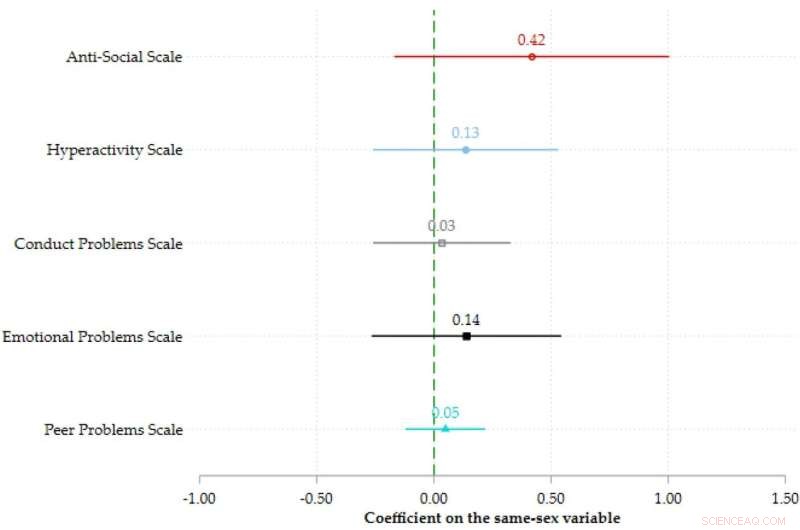
Relationship between having same-sex parents and behavioral scales. The bars represent the 95% confidence intervals. All models have been estimated using coarsened exact matching on gender and age of the child, marriage status of the respondent, education and income of the respondent, whether the child was born outside of the respondent’s current relationship, and the number of children in the household. The sample includes 62 children with same-sex parents and 72 parents with different-sex parents. Credit: International Journal of Environmental Research and Public Health (2022). DOI: 10.3390/ijerph19105922
A study by Dr. Mirjam Fischer and colleagues at the University of Cologne's Institute of Sociology and Social Psychology (ISS) shows that children and adolescents with same-sex parents are just as well adjusted as those with different-sex parents. In this study, 62 six- to sixteen-year-olds with same-sex parents were compared with 72 peers with different-sex parents regarding prosocial behavior, hyperactivity, peer problems, emotional adjustment, and general behavioral problems. The results of the study, "Behavioral Outcomes of Children with Same-Sex Parents in The Netherlands," were published in the International Journal of Environmental Research and Public Health.
Previous studies have shown that same-sex parents face significant stress factors related to their sexual orientation, such as experiences of prejudice and unsupportive legal contexts. On average, this added stress leads to decreased physical and mental health for same-sex parents, which in turn could lead to adjustment problems in their children.
"The new findings clearly show that same-sex families have strong resilience strategies to protect their children from prevailing legal hurdles and societal rejection. For example, parents create an environment in which their children receive appreciation and recognition from others and where other same-sex families provide positive role models. However, it should not be necessary in the first place that parents to have to develop these strategies," said Fischer.
The study is based on unique survey data from the Dutch civil registers and thus provides representative results for families with parents between the ages of 30 and 65 years. The findings are in line with the large number of non-representative research results.
The researchers therefore recommend that researchers and policymakers move away from deficit-driven comparisons between same-sex and different-sex families. Instead, support services for same-sex families should build on their existing resilience structures and strengthen them further.