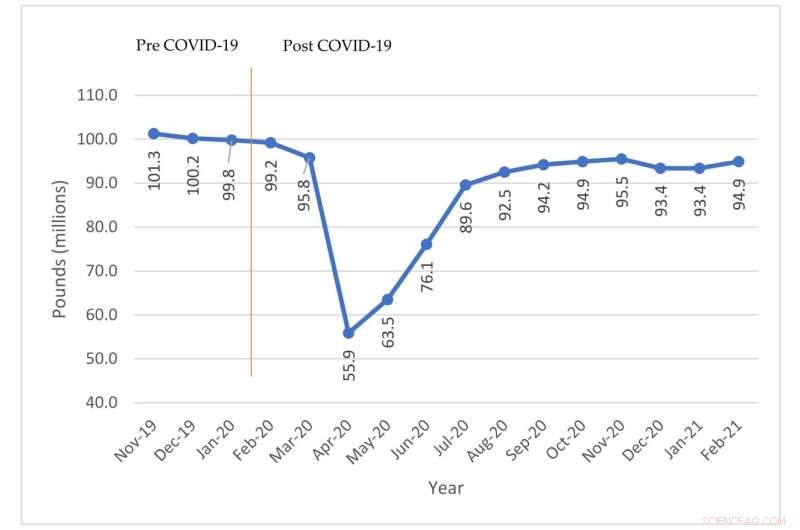
Construction output of the U.K. Credit: Sustainability (2022). DOI: 10.3390/su14106326
Leading world markets face similar problems in creating economically and environmentally sustainable construction industries, international researchers say in a new research article.
As China, the U.S., Australia and other countries struggle to maintain construction industry stability, a new assessment published in Sustainability and led by Malaysia's Universiti Teknologi Petronas Civil and Environmental Engineering experts, with Flinders University, recommends fundamental changes to improve short-term and long-term viability.
A more sustainable approach to construction will tackle urgent environmental imperatives and, in the long run, stabilize major advanced economies to regular construction industry "shocks"—as seen around the world this year, says Flinders University researcher Muhammad Ali Rabbani, who is based in Pakistan.
With construction forming a major plank of the developed economies of China, the U.S. and U.K., the research calls for:
Of the three regions, the research modeling concludes that the U.S. will become a leader in taking advantage of a more sustainable circular economy to rebound from current aftershocks to become a solid economic contributor to GDP.
And while construction accounts for almost 7% of China's GDP and up to 16% of the U.K.'s economy, researchers warn the industry can lead to economic recession and increases in environmental degradation unless new measures are taken to create more sustainable development in future.