Credit: Shutterstock
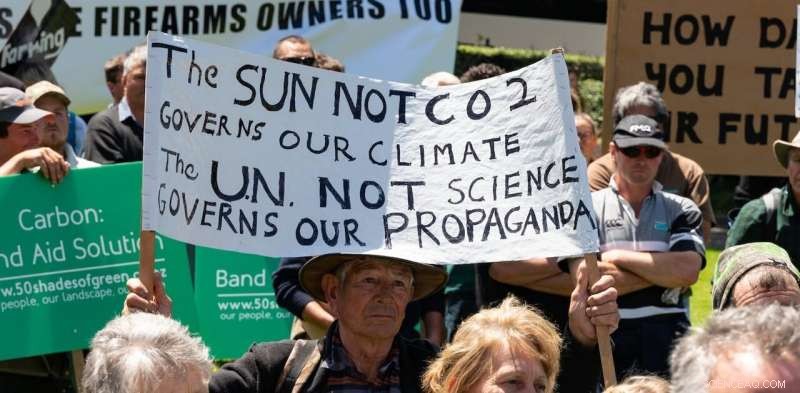
The numbers of climate skeptics are dwindling. But they remain a noisy and at times powerful minority that continues to have political influence. This group is unmoved by the near-universal agreement among scientists on the reality and impact of climate change.
Past research into climate change skepticism has focused on sociodemographics. It has found people are more likely to express skepticism if they are older, male, highly value individualistic beliefs and don't value the environment.
These characteristics are generally entrenched. It means this information, while interesting, may be of little use when trying to increase public support for climate action.
Our latest study of Australian skeptics focused on potentially more malleable factors—including the thought processes of people who reject climate science messaging. Our findings suggest some people reject consensus science and generate other explanations due to mistrust in climate science and uncritical faith in "alternative science."
We hope these findings help researchers, scientists and those responsible for public messaging to understand and overcome skeptics' concerns.
What factors did the study consider?
For our research, we surveyed 390 Australian climate change skeptics. They were recruited via social media, including from skeptic interest groups and websites. We explored whether the following variables predicted climate change skepticism above and beyond sociodemographic factors:
We broke skepticism down into four types based on rejection of, or uncertainty about:
@realDonaldTrump said " The concept of #global warming was created by and for the Chinese in order to make US manufacturing non-competitive."
— Ausenviroman (@terraconcern) September 12, 2020
US leaves Paris climate treaty 4th November.
Leader of the "free world" you must be kidding! pic.twitter.com/PMYJO49jxN
Similar to previous research, our study found:
Unlike in the United States, we found religious beliefs had little influence on climate change skeptics in the largely secular Australian population. Instead, they had faith in "alternative" or pseudo-science explanations.
Those who favored explanations of chance, believing that luck determines outcomes, were also more likely to believe there was no need to act on climate change.
This suggests those who believe outcomes in life are beyond their control are more likely to think individual action on climate change is of little use. Hence, we suggest increased efforts to emphasize the difference individual efforts can make.
Those with stronger individualistic worldviews—their priority is individual autonomy as opposed to a more collectivist worldview—were more skeptical about humans causing climate change.
Contrary to our predictions, people with high analytical abilities were even more likely to be skeptical about this. Our further analyses suggested that mistrust in climate science and uncritical faith in "alternative science" prompted them to reject consensus science and generate other explanations.
How people explain their skepticism
We asked participants to explain their skepticism. From their responses, we identified five overarching themes:
So how do we begin to change minds?
In all, our results suggest climate change skepticism may be influenced by:
Unlike sociodemographic characteristics, these thought processes may more open to targeted public messaging.
In the end, reality bites. Multi-year droughts and successive never-before-seen floods will struggle to fit a skeptic narrative of yet another "one-in-100-year event." Even the attitudes of Australian farmers, including some of the most entrenched skeptics, are shifting.
Climate change is upon us, and skepticism is rapidly becoming a topic for historians, not futurists. + Explore further
This article is republished from The Conversation under a Creative Commons license. Read the original article.