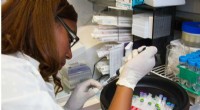
Chemistry-focused science fair projects are ways for students of any age to showcase their scientific knowledge. With a chemistry science fair project, students learn about and observe chemical processes in real time while also learning how to record the results of experiments and present them to an audience. Elementary school students can conduct simple experiments with harmless chemicals found in their own homes, while middle school and high school students may choose to work with chemicals that are more volatile or difficult to find. For example, elementary school students can make a color-changing liquid from cabbage. Middle school students can boil common household beverages to determine their sugar content, and high school students can test how well different substances ferment yeast.
Chemistry science fair projects showcase the scientific knowledge of students from elementary school to high school. For example, elementary school students can use cabbage juice to make a color-changing liquid, middle school students can boil different beverages to determine their sugar content, and high school students can test the efficiency with which different substances ferment yeast.
The objective of color-changing cabbage project is to determine the pH of a homemade liquid by watching it change color. This project works well for young science fair participants, such as those in elementary school. For this project, students need a small red cabbage, a strainer, a pot of boiling water, white paper cups, a medicine dropper, two large bowls and a variety of household liquids. These liquids can include fruit juice, soda, vinegar, baking soda solution or household cleaners, although safety equipment, such as rubber gloves, should be used when working with harsh cleaners. This project requires adult supervision and assistance.
Students can record their findings and use a pH chart (see Resources) to figure out how each household liquid changes the cabbage liquid's pH. They can then present these findings along with a display as part of the project. Samples of the different-colored liquids may be used as part of the display as well, as long as they are kept in sealed containers.
This chemistry-focused science project regarding sugar content uses safe, easy-to-find materials, but it requires careful weighing and recording of data, which makes it perfect for middle school students. The objective of this project is to figure out the sugar content of common beverages by weighing the sugar in each. Because it involves boiling water, students may need adult supervision. For this project, students need a pot, a stove, a scale, fruit juice, soda, and any other household beverage that contains sugar, such as flavored water or artificially flavored mixed juices.
Repeat this process for each beverage and create a chart of the findings. The results of this experiment can be presented as a science project along with a display.
The purpose of the fermenting yeast project is to determine how efficiently polysaccharides ferment yeast. Because the project requires the use of specialized equipment and the use of chemicals that need to be special ordered by the student or the student's school, this project is best completed by experienced high school students. For this project, students need droppers, graduated cylinders, test tubes, three volumetric flasks, cellulose, maltose, sucrose and yeast.
The procedure for this project is complex.
The carbon dioxide bubbles are an indicator of how fast the yeast is fermenting. The more bubbles there are, the more quickly it is fermenting.
Record these results in an easy-to-read chart or graph and present it along with visual aids as a science fair project. An explanation of the basic fermentation process and photographs of the experiment itself enhance audience understanding.