Credit: Shutterstock
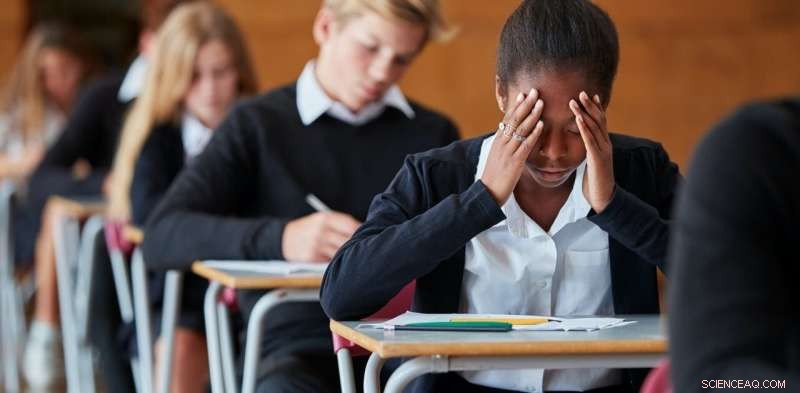
Many kids across Australia are heading back into classrooms after months of lockdowns and remote learning. Understandably, students may be anxious about what the uncertainty of the return may mean for them academically and socially.
Some may have existing worries at home, such as financial strain in the family, that can impact on their mental health.
Research has shown anxiety and depression grew among young people during the pandemic. While social and emotional effects of anxiety are often explored, many people may not realize anxiety can have a significant impact on children's academic work too.
A panicky feeling
One in seven Australians are currently experiencing anxiety. The prevalence of anxiety among children is a cause for concern: 6.1% of girls and 7.6% of boys. And research shows the median age onset for anxiety is 11 years.
Importantly, these were statistics before the pandemic. In August this year, the Journal for the American Medical Association (JAMA) published research showing 25% of young people globally were experiencing clinical anxiety. The study showed the prevalence of depression and anxiety symptoms during COVID-19 had doubled compared with prepandemic estimates.
Anxiety is when you feel uncomfortable nervousness, worry, light-headedness, an increased heart rate, a churning stomach, restlessness, and/or a panicky feeling.
We are supposed to feel anxious or a little worried before stressful situations, such as taking an exam, as it motivates us to perform better. But while anxiety serves an important function, it is a problem if it starts to become unbearable and interfere with our daily function.
How it can affect kids' academic abilities
Attentional control theory provides a well-supported explanation for how anxiety might play out in the classroom. The theory holds that heightened anxiety impairs the efficiency of mental processes (executive functions) but does not always hinder the accuracy of performance.
Research demonstrates the negative impact of anxiety on executive functions in adults. It can affect our inhibition (the ability to control an impulse), shifting (where we switch or shift between tasks or demands), and updating (monitoring and updating information in the cognitive system where information is stored and manipulated for us to complete a task—known as working memory).
Some studies have examined the consequences of anxiety-linked problems with executive function when it comes to academic achievement in children. But research is still limited.
One study found the ability to inhibit and shift attention, and update information in working memory, were associated with issues with literacy and numeracy. For example, poorer updating (or working memory) was related to poorer maths, whereas poorer inhibition was associated with poorer overall grades.
Our laboratory is currently testing precisely how anxiety implicates children's cognitive processes and in turn, classroom achievement. But here is what we speculate so far.
How the theory can help explain classroom difficulties
Based on attentional control theory, it is likely the attention of a child experiencing heightened anxiety might be drawn towards worrisome thoughts rather than their classroom task.
A child might be unable to control their thoughts. For instance, they may think this work is too hard or they might fail. This can lead to trouble shifting their focus to concentrate on academic work.
When new information is presented, a child's working memory requires updating and their attention needs to stay focused on the task to absorb new material.
But, if attention is being drawn towards task-irrelevant information like the negative thoughts, then performance is less efficient (takes longer) and sometimes less accurate (of poorer quality).
So, what can teachers and parents do to help?
Tips for parents and teachers
There is a lot teachers and parents can do to help, but here are ten tips:
Keep in mind that providing a calm environment allows the child to improve their executive functioning and maximize their potential to achieve at school.
Importantly, taking this approach provides a feedback loop of improvement, that is, the more the child feels successful, the less they worry.
This article is republished from The Conversation under a Creative Commons license. Read the original article.