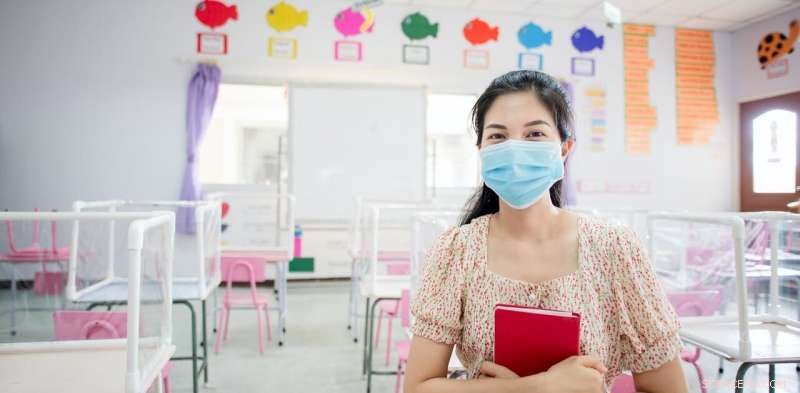
For those who teach children ages five and under, communicating while wearing a mask may have special challenges. Credit: Shutterstock
As governments around the world debate the conditions for reopening schools, some regions have mandated that teachers wear masks when school resumes. Concerns have been expressed about loss of learning opportunities for linguistically diverse students and for children who read lips. For kindergarten and primary teachers, teaching younger children while masked also presents challenges—specifically related to students' social-emotional learning.
Non-verbal cues carry up to 55 percent of the emotional content of messages. Without those cues, a lot of important information is missed.
Furthermore, the mouth and eyes are even more important than other facial features when interpreting expression. In contrast to adults who get most non-verbal social information from speakers' eyes, young children pay most attention to speakers' mouths. This elevates the challenge of clearly communicating emotions to children while wearing a mask.
Research has shown the "ability to encode, interpret and organize emotional and social information are skills needed to both engage in learning, and to develop self- and social awareness and make responsible decisions." These social-emotional skills are recognized as critical developmental skills in early childhood.
Clear communication of emotions
There is broad consensus between experts that positive relationships are more likely to develop when people communicate clearly, feel understood and can understand others' feelings in safe environments. Positive student-teacher relationships result in greater pro-social behavior, school engagement and academic success in students, and lower levels of burnout in teachers.
Teachers experience additional risks
The potential emotional and social losses for both students and teachers presented by masking are further exacerbated by potential physical injury to teachers. Vocal strain is a significant occupational hazard in teaching, and the increased volume necessary to be understood when wearing a mask may contribute to this risk.
Wearing masks is now recommended in schools in Canada and the United States, for example, so it is imperative to look for solutions that mitigate the negative social, relational and physical effects on students and teachers. Teachers can learn from strategies developed by masked pediatric nurses to meet the shared teaching/nursing goals of expressing care, communicating clearly and promoting trusting relationships that foster a sense of safety.
Many of the challenges teachers will face in classrooms will mirror the challenges of mask-wearing nurses who provide care to pediatric patients. Nurses can be a source of practical solutions for these barriers, based on their clinical practices. The strategies presented here can enhance the learning experiences of young students in the new world of COVID-19 aware classrooms.
This article is republished from The Conversation under a Creative Commons license. Read the original article.