
"The Bread Famine and the Pawnbroker." Credit: Brothers Lesueur
When our reliance on supermarkets is seriously disrupted—for example, by spikes in demand due to panic buying or the flooding of distribution centers – we are left with few alternatives. Supermarkets are central to our everyday lives, but they have also become symbols of our vulnerability in times of disruption.
The COVID-19 crisis has caused us to rethink many things we took for granted. This includes the plentiful supply of a great variety of food at relatively stable prices in our supermarkets.
Until recently, if we thought about food security at all, it was more likely to conjure images of malnutrition in countries of the global south rather than empty supermarket shelves.
However, food insecurity exists in Australia. It can be experienced as hunger and also as feelings of anxiety about future food shortages.
The rise of supermarkets and global supply chains
Supermarkets were a 1930s success story that began during the Great Depression. The world's first supermarket, King Kullen, opened with the enduring principle of "Pile it high, sell it low!" King Kullen became the standard model of supermarket operations with globally interconnected supply chains.
While this model epitomized the trend of globalization, during the second world war more local food production was encouraged in the form of "victory gardens". These made a significant contribution to food security during the war years. It was a demonstration of what can be achieved in times of crisis.
"What if' questions help us build resilience
Contingency planning is about being clear on your Plan B or Plan C if Plan A hits trouble. It's about asking the "what if" questions. As a planning tool, this enables systems to build resilience to disruption by identifying other pathways to achieve desired outcomes.
The difference between now and the 1930s is that today we are vastly more connected at a global scale. Within our food-supply chains, we can use the knowledge that comes from this greater connectivity to ask different "what if" questions.
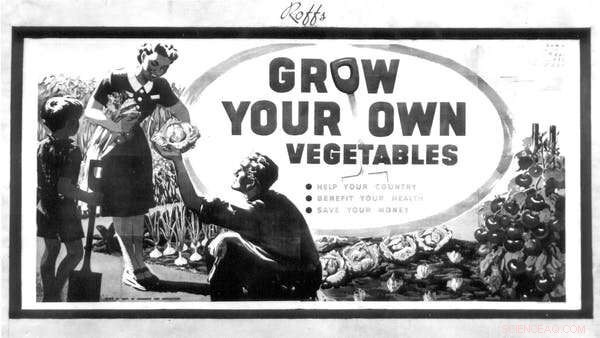
An Australian government ‘Grow your own’ campaign billboard from 1943. Credit: NAA C2829/2
For example, what if a pandemic and a severe weather event overlapped, disrupting critical transport infrastructure? How could we adapt?
Or what if several Australian states experienced serious disruptions to food supply at the same time? How could we ensure timely resupply?
Recent experiences of empty supermarket shelves remind us of the importance of such questions.
Greater self-sufficiency is sensible and practical. Australia's National Strategy for Disaster Resilience makes clear that we should understand the risks we live with—in this case, our deep-seated and often unquestioned dependency on long food-supply chains.
The strategy also calls for authorities to help empower citizens to share responsibility where they can in building their own resilience to hardship. This taps into a primal urge, as we have seen in the recent spike in demand for seedlings and vegetable plants at nurseries as people take to home gardening, digging not so much for victory as for survival during a shutdown.
Strategies to prepare for the next crisis
These questions highlight the need to think about ways to complement and enhance existing arrangements for supplying food. Our research identifies several immediate opportunities to promote shorter food-supply chains and devise contingency food plans:
Societies have faced significant food and health crises over the centuries. Now, though, we have almost real-time data on food production, stocks and supply chains. Would it not be sensible to strengthen local food systems that can complement our supermarkets and global networks?
If we don't do this, the only lesson we will have learned from the coronavirus crisis is to start hoarding baked beans, toilet paper and hand sanitizer as soon as we first hear of a looming disaster.
This article is republished from The Conversation under a Creative Commons license. Read the original article.