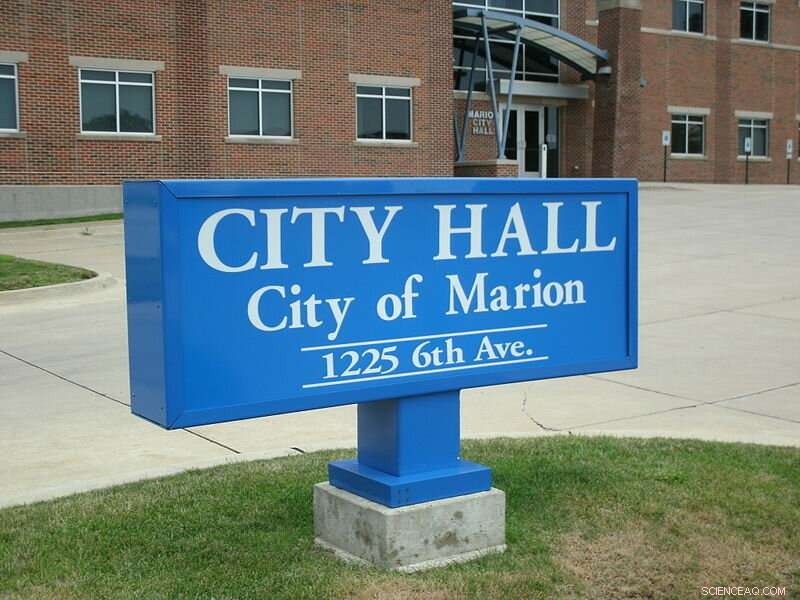
Marion, IA city hall. Credit: RifeIdeas/Creative Commons Attribution-Share Alike 3.0 Unported
Americans of all walks of life are working together to slow the spread of COVID-19 by practicing social distancing. Public agencies are doing their part by closing offices to the public, canceling or postponing hearings, and shifting services and proceedings to virtual formats. In this post we look at the role of open meetings laws in providing for transparent proceedings, and suggest a set of best practices for ensuring that state environmental agencies, public utility commissions, and local governments cultivate meaningful public participation while weathering this pandemic.
Last week, advocates called on the Trump Administration to hold open all active comment periods for pending rulemakings while the Declaration of a National Emergency remains in effect. Critical environmental decisions are also occurring at the subnational level, where states and cities are acting as first responders to COVID-19. A number of states have suspended aspects of their open meetings laws in response to the pandemic, and many public bodies are now holding meetings telephonically or using videoconference technology—and conditions are changing on an almost daily basis. New York, for example, suspended its open meetings law requirement that members of the public be permitted to attend meetings in person, and authorized public meetings to be held remotely "by conference call or similar service" so long as the public can observe or listen in. Illinois has suspended the legal requirement that members of a public body must be physically present to assemble, as well as restrictions on remote participation. Massachusetts has lifted its open meetings law's mandate that public entities meet in a public place, so long as alternative means of public access are provided. Texas is similarly allowing government meetings to take place by phone or videoconference. These moves are plainly necessary, but states should ensure that substitutes for in-person meetings satisfy the overarching goal of open meetings laws.
Cities face similar challenges, and are not escaping the attention of advocates working to ensure public participation is not lost in the midst of pandemic responses. For example, last week Sean Hecht, director of UCLA's Environmental Law Clinic, asked Los Angeles to postpone deadlines for public comment on environmental review of planning matters until after the city lifts its "Safer At Home" order. Professor Hecht points out that the public is no longer able to view crucial documents at city offices or libraries and cannot assemble in order to coordinate their comments.
All 50 states have open meetings laws prohibiting governmental bodies from deliberating or making decisions in private in order to ensure transparency. While the details vary, open meetings laws share the objective of ensuring that the public is informed about government decision-making. A number of states' open meetings laws allow for remote participation, but only under narrow circumstances that would not allow business to continue as usual throughout the COVID-19 crisis. For example, Virginia law allows a public body to meet electronically during a state of emergency if 1) meeting in person would be unsafe, and 2) the purpose of the meeting is to address the emergency. Needless to say, this statute does not allow Virginia agencies to address routine business by meeting electronically for the next few weeks or months. Other states allow for remote participation in public meetings, but in formats that are simply impractical today. In Idaho, for example, meetings may be conducted telephonically or by videoconference, as long as one member of the governing body is physically present at the public entity so that members of the public can attend the meeting in person. Similarly, a Michigan Appellate court has held that a public agency did not violate the state's open meetings law by holding a gathering in two locations that were connected by conference call, because the public could attend the meeting at either spot. These precise formats are clearly impractical in our current moment.
All this suggests that it is possible to follow the spirit—if not the letter—of open meetings laws even when members of the public cannot physically share a room with public servants, because meetings can remain open to the public through virtual means. Moreover, while the constitutional dimensions of virtual proceedings in the context of COVID-19 have not been tested, we know that the Supreme Court has held in other circumstances that the precise requirements of due process are flexible and fact-specific. The recommendations below provide some suggestions as to how public entities can ensure transparency and public access to information while protecting public health by maintaining social distancing. The Administrative Conference of the United States and the New York Conference of Mayors have provided further guidance.