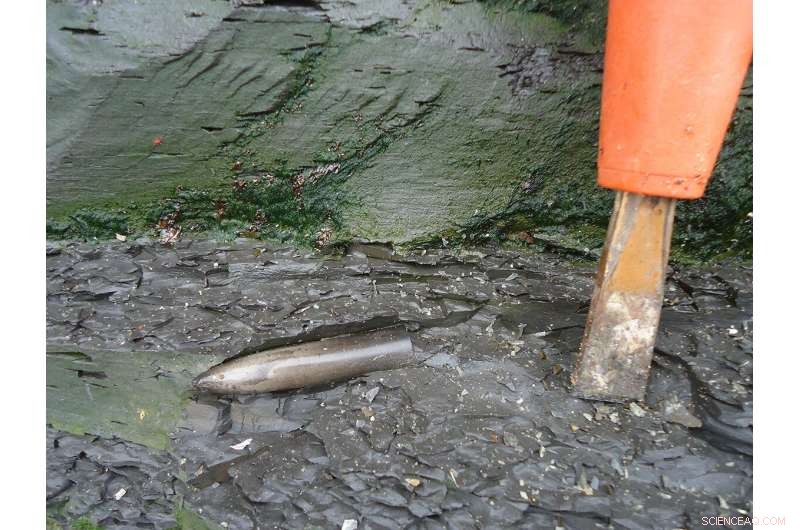
Credit: FAU/Patricia Rita
A team of palaeontologists at GeoZentrum Nordbayern at Friedrich-Alexander-Universität Erlangen-Nürnberg (FAU) recently investigated how prehistoric organisms react to climate change, basing their research on belemnites. These shrunk significantly when the water temperature rose as a result of volcanic activity approximately 183 million years ago, during the period known as the Toarcian. The FAU research team published their results in the online publication Royal Society Open Science.
"Belemnites are particularly interesting, as they were very widespread for a long time and are closely related to the squid of today," explains palaeontologist Dr. Patricia Rita. "Their fossilized remains, for example the rostrum, can be used to make reliable observations."
The DFG-funded research project "Temperature-related stresses as a unifying principle in ancient extinctions," confirms a hypothesis that climate has a significant influence on the morphology of adult aquatic organisms. The body size of dominant species fell by an average of up to 40 percent.
The researchers believe that this "Lilliput effect" was a precursor to the later extinction of the animals. It is still unclear whether rises in temperature influenced the organisms' metabolism directly or indirectly, for example, due to a shortage of food sources.