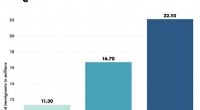
Gender and sexuality are major factors in shaping the experience of Harris County residents, often inequitably, a new report finds. Credit: University of Houston
A new study by the University of Houston Institute for Research on Women, Gender & Sexuality (IRWGS) reports that women lag far behind men on multiple fronts in Harris County. Women are almost 50% more likely to live in poverty than men and the wage gap for men and women by race and ethnicity is considerably greater here than nationally. The report presents both new and summary analyses of select data on gender and sexuality, derived from the 2017 American Community Survey and other sources.
"These and other data in the report demonstrate that gender and sexuality are major factors in shaping the experience of Harris County residents, often inequitably. We've made some progress in moving toward equitable inclusion of all talented workers in the workforce including women, but there's far to go," said IRWGS director Elizabeth Gregory. "An important element seems to be that we haven't found a way to equitably provide child-care support for working families. As a result, mothers get stuck slowing their careers where it might not be to their, their family's or the community's advantage to do that."
Key findings of the report include:
Gregory notes that the LGBT community is incompletely documented due to persistent social risk.
"Data on the LGBT community is limited, like much gender and sexuality data that operates in a context of risk —in this case due to lack of employment protection and other social stigma," said Gregory. The center works to responsibly document such data in ways that minimize risk.
Founded in 2019, the University of Houston Institute for Research on Women, Gender & Sexuality is the region's first gender and sexuality focused think tank. The institute's goal is to provide evidence-based data and analyses to amplify discussion around the social and economic forces linked to gender and sexuality that have long gone unexamined and to engender positive change.
"Instead of taking gender and sexuality disparities for granted as inevitable, people should start talking about them over dinner with friends and asking, 'How can we alter this?' 'What are the real economic dynamics of gender, and how can they be improved upon?' While gender has long served as a work-assignment system and has given men and women different jobs in the home and workforce and different pay scales, the old patterns don't make sense anymore, for employers or for families," said Gregory.