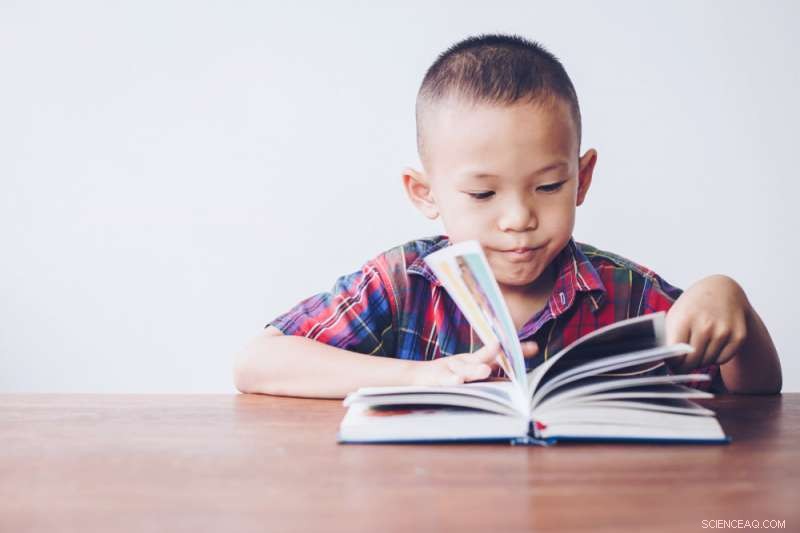
Boys typically read less frequently and perform worse on national and international reading assessments than girls. Credit: www.shutterstock.com
The OECD consistently finds girls perform significantly better than boys in reading. This gap can also be observed across the Australian NAPLAN reading data.
Research suggests reading more can improve literacy outcomes across a range of indicators. But girls typically read more frequently than boys, and have a more positive attitude toward reading.
Parents read more with their daughters. This sends a strong and early message that books are for girls, as well as equipping girls with a significant advantage. Recent research found even though boys read less frequently than girls, girls receive more encouragement to read from their parents.
So how can parents and educators help bridge the gap for boys' literacy?
Stop telling boys they only like non-fiction
To improve boys' literacy outcomes, parents and educators may look for ways to connect boys with reading. This had led to discussion about the importance of promoting so-called "boy-friendly" books that boys are supposedly "drawn to", which are typically assumed to be non-fiction works, as it's regularly contended that boys prefer to read non-fiction.
But this contention is not typically supported by recent quantitative research. For example, OECD and my own research suggests boys are more likely to choose to read fiction than non-fiction. Encouraging all boys to read non-fiction under the assumption this meets an imagined uniform preference can actually lead to negative outcomes.
Firstly, the reading of fiction is more consistently associated with literacy benefit than non-fiction in areas such as verbal ability and reading performance. When we tell boys non-fiction books are for them, this may steer them away from a more beneficial text type. This is counterproductive if we're doing so in order to improve their literacy.
Secondly, recent research suggests non-fiction readers tend to read less frequently than fiction readers. So, if we want to increase boys' reading frequency, engaging them in fiction may be more effective.
We may also be encouraged to steer boys toward comic books. While children can benefit from exposure to diverse text types, the reading of comic books, e-mails and social networking posts, newspapers, magazines and text-messages is not associated with the same level of literacy benefit.
In addition, recent research supports the relationship between reading fiction and the development of pro-social characteristics such as empathy and perspective taking. So reading fiction can help students to meet the Personal and Social Capability in the Australian Curriculum, among other general capabilities. Instead of buying into stereotypes, we should aim to meet our children's individual reading interests and encourage a reading diet that includes fiction.
Six strategies for connecting boys with books
Here are six strategies you can use to connect boys with books and increase their reading engagement:
As a final comment, the OECD note: "Although girls have higher mean reading performance, enjoy reading more and are more aware of effective strategies to summarise information than boys, the differences within genders are far greater than those between the genders."
So, parents and educators seeking to support the literacy attainment of young people through increased reading engagement should focus on meeting the needs of all disengaged and struggling learners, regardless of gender.
This article is republished from The Conversation under a Creative Commons license. Read the original article.