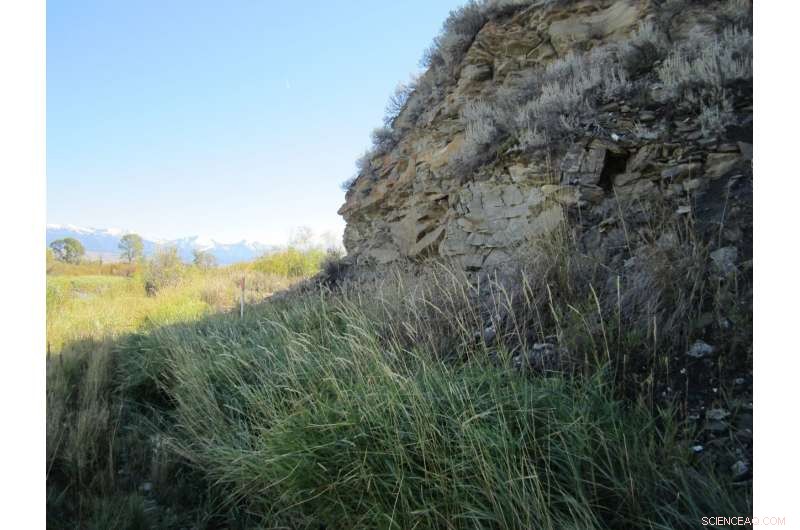
The Anzick site in Montana. The white post signals where the burial was found. Credit: PNAS
A team of researchers from the University of Oxford, Texas A&M University and Stafford Research LLC has found evidence bolstering the theory that the skeletal remains of an infant unearthed in Montana are those of the only known Clovis burial. In their paper published in Proceedings of the National Academy of Sciences, the group describes their testing methods and what they found.
In 1968, construction workers came upon the remains of an infant skeleton. Those remains became known as Anzick-1 and were believed to represent a member of the Clovis people. The Clovis people are believed to have been the first widespread group of people living in North America. Prior research has suggested they lived approximately 13,000 to 12,600 years ago. Their name comes from the distinctive Clovis-style projectiles they created.
In the years after Anzick-1 was found, teams of researchers studying the remains found mixed results when testing for age. Some showed the remains as very nearly the same age as nearby Clovis artifacts, while others found the remains to be thousands of years more recent. In this new effort, the researchers sought to settle the matter once and for all using new and improved dating techniques.
The new techniques involved using pretreatments of collagen found in the remains to factor out decontamination and for extracting a single amino acid for radiocarbon dating. The researchers report that all of their tests showed that antlers found near the burial site and the skull of a second specimen (Anzick-2) were roughly the same age—which was approximately the same as prior testing had shown. But some of the testing showed the remains of Anzick-1 to be approximately 1000 years younger. Another test the team performed, though, called HYP extraction, showed the infant remains to be approximately the same age as the antlers and Anzick-2. The differing results from the other tests, the researchers suggest, were likely due to contamination issues. They contend that because HYP is the more precise measurement technique, their results show that Anzick-1 is approximately the same age as the other artifacts. And this, they claim, suggests that the debate about the age of the remains should be considered resolved.
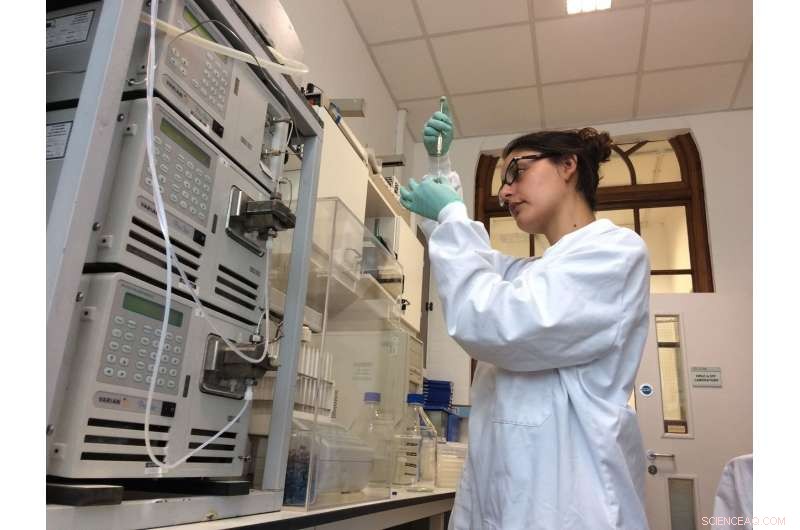
Lorena Becerra-Valdivia at the Oxford Radiocarbon Accelerator Unit (ORAU), University of Oxford, working on the equipment (HPLC) that was used to extract hydroxyproline from the Anzick site bone samples. Credit: Eileen Jacob (University of Oxford, Oxford).
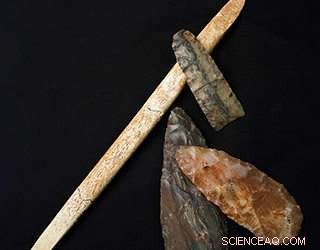
Artifacts from the Anzick site. Credit: Texas A&M University
© 2018 Phys.org