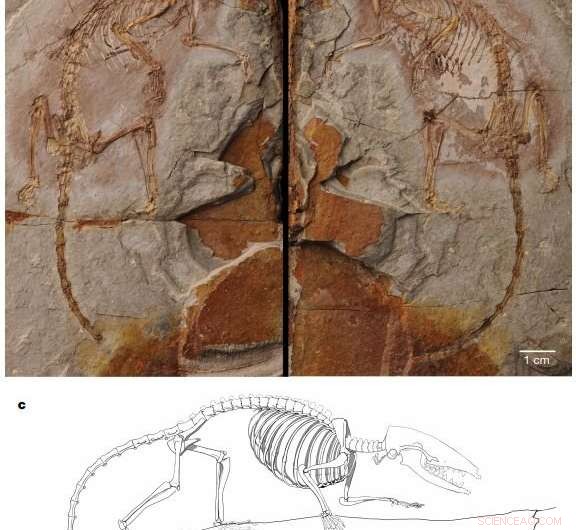
| Holotype specimen of A. zhoui STM33-5, Tianyu Museum of Nature, Shandong Province, China. a, Main slab A. b, Counterpart slab B. c, Restoration. Credit: Nature (2018). DOI: 10.1038/s41586-018-0210-3
A team of researchers from China and the U.S. has identified a new ancient mammal ancestor recently found in a part of China. In their paper published in the journal Nature, the group describes the creature, which they have named Ambolestes zhoui, and where it fits in the ancestral tree.
The well-preserved (and nearly complete) skeleton was unearthed in Yixian County in a northern part of the Inner Mongolia Autonomous Region—it has since been dated to approximately 126 million years ago, and has been identified as eutherian (a group that includes placentals but not marsupials and monotremes). The team reports that it had two physical features that are not found in modern mammals: an ectotympanic and hyoid apparatus. The first is a bony ring used to hold the eardrum in place. The second is a U-shaped bone that supports the tongue.
The researchers note that the remains are part of a large collection of ancient vertebrates uncovered in the area over the past 20 years—approximately 120 species from the area have thus far been identified. Most of those, they note, have been dated to the Early Cretaceous Jehol. Therian mammals, they add, are rare finds in the area. Testing of the remains has included use of both CT scans and 3-D technology as a means of identification and reconstruction of original features. The results are remarkably detailed images of bones and teeth with accompanying labeling and explanatory details.
The researchers report also that the mammal remains were those of a creature of placental lineage, but which had features consistent with marsupials. These findings indicate that Asia may not be the place of origin for marsupials. They note also that prior research has suggested that the placental and marsupial mammal divergence likely occurred during the Jurassic period. The point out that the oldest known metatherians were those found in North America and dated to approximately 110 million years ago.
The researchers also used their paper to announce the establishment of a new database that will hold lineage information surrounding early mammals.
© 2018 Phys.org