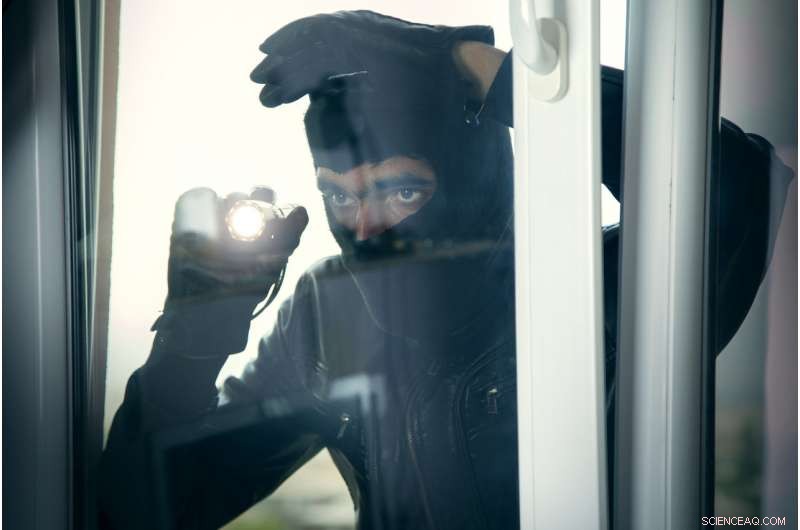
Break-and-enters are increasingly viewed as a precursor to sexually violent crimes. So why do police forces misclassify and mischaracterize them? Credit: Shutterstock
Conventional thinking has suggested for years that predatory offences like exhibitionism or actual sexual assaults are typically the early crimes committed by future serial sex predators.
But the reality is that residential break-and-enters are common among incarcerated sex offenders as their first, or gateway, offence en route to becoming high-risk violent serial offenders, whether homicidal or non-homicidal.
A recently published Canadian study confirms that of 624 convicted and federally incarcerated sex offenders, including sexual and serial murderers, interviewed over a six-year period, breaking-and-entering was the prevailing first offence committed during the formative years of their criminal careers.
Indeed, the study suggests, breaking into residential dwellings is more likely to be sexually motivated than previously thought.
Police, however, still wrongly assume when nothing is stolen in a break-in and there seems to be no obvious financial motive that the offender was either scared off, aborted the crime for some other reason or was otherwise just indulging in petty mischief.
The police approach to break-and-enter investigations is still languishing in the dark ages across much of Canada. Both investigative and analytical methodologies have failed to keep pace with the forensic and academic literature. Some police services are worse than other, and they know who they are.
What's even more disturbing is that their approach may allow incipient sex offenders and serial predators not only to go free, but to go entirely undetected.
In my companion piece for The Conversation Canada on how police "cook the books" to inflate their solved crime rates, I touched on the fallacy of break-and-enter crime data in Canada.
One of the inevitable consequences of police forces' statistical manipulation through systemic unfounding and recoding of crimes is how it consequently allows potential sex offenders to go unrecognized at the critical point in their developing criminal careers.
(Unfounding means that the occurrence is considered a non-event and baseless. Recoding is a method police use to reclassify an offence at their discretion.)
Due to these police tactics, potential serial sex offenders can avoid apprehension, identification and arrest before they inevitably escalate in their crimes.
There is an erroneous assumption among many police brass that B-and-Es are easily relegated to being "victimless" offences and otherwise innocuous "property crimes" unless there is overt evidence of fetish activity at the scene, or unless there is an actual attack on an occupant —what is still rather ridiculously described in some cases as a "burglary gone wrong."
Burglaries 'gone right' for perpetrators
In reality, these are burglaries gone right —the key is recognizing why the offender was in the residence to begin with.
The Canadian study in part validates earlier research and expert input that strongly recommended that DNA evidence from B-and-Es should be included in the National DNA Data Bank, this despite the fact that they weren't widely regarded as sex offences.
Original research conducted by expert staff at the Center for Homicide Research in Minneapolis has now identified a total of six sub-types of sexually motivated residential break-and-enters that are often indicative of a pathway toward violent future sex offending, including sexual homicide.
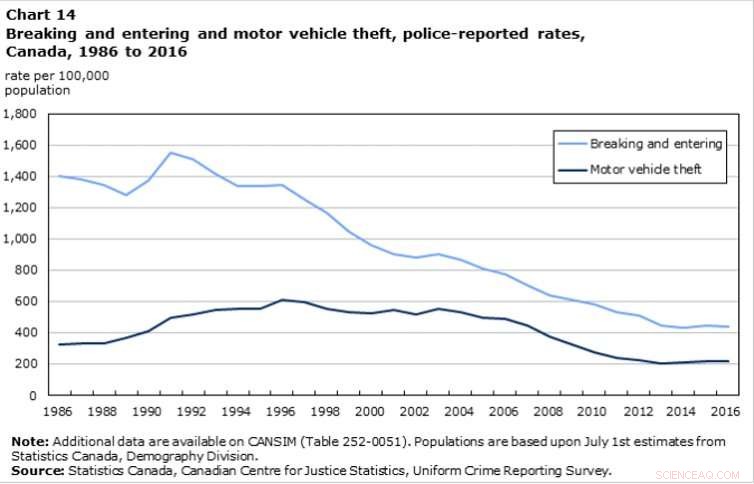
There is one thing all of these sub-types have in common: They're the most likely to be declared unfounded, recoded as an "attempt" only (thus not a completed incident by StatCan standards) or recoded as mischief, a trespasser or some other misrepresentative category.
And then the cases are closed in what are known as "first and final" investigations.
In each of these circumstances, a break-in investigated solely through the lens of material gain means missing the point of many, if not most, residential burglaries. These crimes are therefore not properly flagged for full investigation.
This could also in part explain the otherwise puzzling drop in "completed" and "founded" break-ins in Canada over the last 10 years that seems at odds with declining socioeconomic conditions in many communities across Canadian communities.
In reality, however, supposedly "unfounded" or "attempted" cases are the ones that actually merit the most investigative attention.
That's because, unlike a conventional break-in where items have been stolen, the intruder who was merely looking and took nothing is not pursued at all, even though he may have had far more sinister motives. He is free to continue experimenting and escalating in his methods. Chances are, he is described below.
The six sub-types
Continue in their crimes
As I stress in my public talks, the lack of awareness and training surrounding these six burglary typologies, and the fact that they're often miscoded and misidentified, is the single biggest blind spot in the accurate tabulation of break-and-enter data nationally.
It's also the single biggest loophole that allows escalating and still nascent sex offenders to often continue in their crimes, increasingly emboldened as they go unrecognized and undetected.
What are known as administrative clearances have, in the past, allowed a series of crimes to be conveniently attributed in bulk to a single offender with a similar background in order to artificially inflate a police force's solved crime rate.
In a similar manner, being dismissive of B-and-Es in order to keep cases off the books entirely serves as a significant threat to public safety, all in interest of numbers in most cases.
Doing so not only contorts the data, it allows offenders whose break-ins are clearly sexually motivated —and who conform to one or more of the six subtypes —to elude recognition. They then often move on from B-and-Es to more significant (and dangerous) sexual offences because their early crimes go unnoticed and largely undocumented.
The result is an unknown number of potentially (and likely) high-risk offenders going unrecognized and lost in the oblivion of dishonest statistics.
It is time to change the conversation.
This article was originally published on The Conversation. Read the original article.