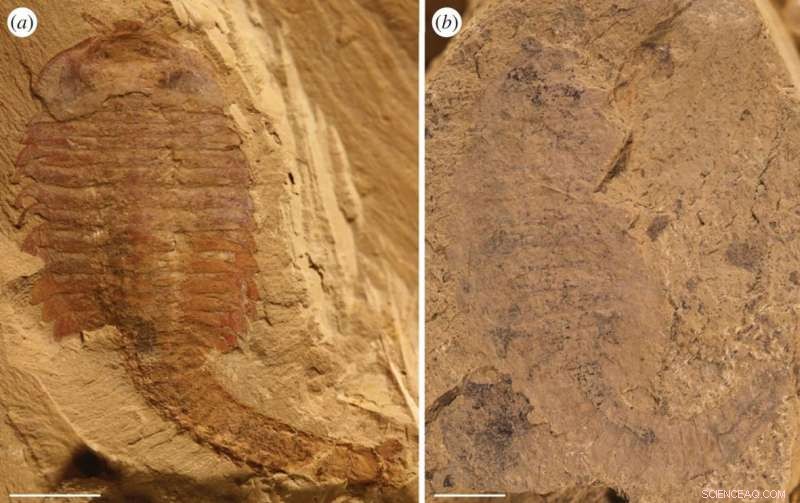
Fuxianhuia protensa from an ‘event bed’ (EB) and a ‘background bed’ (BGB) of the Chengjiang Fossil Lagersta¨tte, showing typical differences in preservation. (a) EB fossil (ELI-JS721) showing excellent preservation of the external anatomy (e.g. the head shield, trunk tergites, antennae and stalked eyes). (b) BGB fossil (ELI-JS327A) preserving only remains of the gut and very faint segmentation in the partly decayed cuticle. Scale bar equals 5 mm. Credit: Proceedings of the Royal Society B: Biological Sciences (2018). DOI: 10.1098/rspb.2018.0051
A small team of researchers from Germany and China has found evidence that suggests ancient preserved circulatory and nervous systems found in Chengjiang, China, are actually the remains of biofilms. In their paper published in Proceedings of the Royal Society B, the group describes their study of hundreds of fossils collected from the Chengjiang site and what they found.
Approximately 10 years ago, researchers studying remains uncovered at the Chengjiang site started making claims that they had found samples of nervous systems and veins in some of the fossils they were studying—suggesting that such soft material had somehow survived intact for approximately 520 million years. They further claimed that the material had survived due to the unique nature in which they had been preserved. The ancient creatures were covered with mud almost immediately after death, sealing them away from decaying elements. The researchers with this new effort disagree—the material resembling brains and soft body parts, they suggest, is much more likely to be biofilm remains.
The researchers came to this conclusion by studying over 800 fossils uncovered at the Chengjiang site. As part of their investigation, they looked at differences between the fossils, noting that they should look somewhat the same. Brains, they note, from two different fossils should look quite a bit alike, regardless of the preservation method—but they found a lot of variation. They noted also that some of the fossils with so-called soft remains had come from what are deemed event beds—where a creature was covered with mud almost immediately after death. But some also came from what are known as background beds, in which the creature was covered more slowly, and tellingly, a very unlikely scenario for long-term preservation. They also noted some examples in which the hard shell of an ancient creature had been lost, but its soft inner material had still been somehow preserved, a very difficult proposition to swallow.
The researchers then conducted some reenactments with modern creatures such as shrimp, noting how they decayed when covered with mud soon after death. Even under such conditions, they note, the soft tissue was always the first thing to decay.
The researchers conclude by suggesting that the material thought to be brains or other nervous system parts, or veins, is instead more likely the remains of biofilms.
© 2018 Phys.org