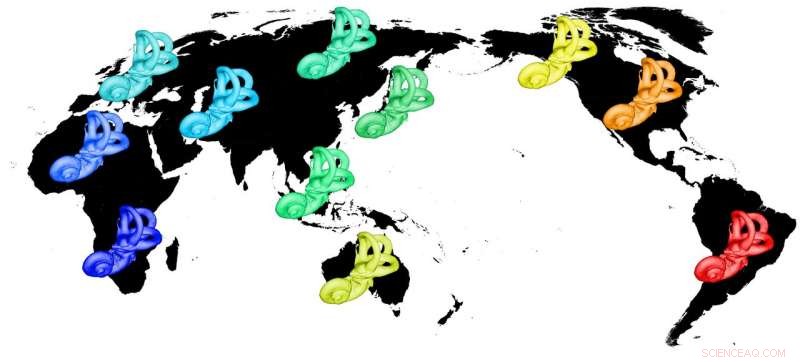
The inner ear of modern humans shows subtle shape differences between populations, tracking human dispersal from Africa (colors symbolize dispersal distance from sub-Saharan Africa). Credit: PNAS
An international team of researchers has found that it is possible to use the human bony labyrinth of the ear as an indicator of dispersal from Africa. In their paper published in Proceedings of the National Academy of Sciences, the group describes their study of hundreds of ancient ear bones from around the world and the differences they found among them.
As archaeologists continue to piece together human history, they look for new ways to interpret evidence that may already be in hand—such as ancient human bones or fossils. By studying the way the skeleton has changed from the time when our ancestors were in Africa until today, researchers have created a kind of map of the migration of humans around the world. In this new effort, the researchers focused on the bony labyrinth, the three bones of the inner ear—the cochlea, vestibule and semicircular canals. Together, they appear as a sort of labyrinth for which they were named. The researchers started with the knowledge that as time passes, bone structure tends to change—and the bony labyrinth has proven to be particularly hardy, remaining mostly intact in skeletons when arms, legs and other bones have been broken, crushed or lost completely. They further noted that earliest humans that migrated from Africa would have had the longest amount of time to evolve as they moved to other places. And those that migrated the farthest would likely be among those who migrated the earliest. This, they believed, suggests it should be possible to use evolutionary changes in the bony labyrinth as a means for charting human migration.
To test their theory, the researchers collected and analyzed 221 skulls, which included 22 unique populations from various time periods. They looked at the differences in the bony labyrinths, and once they had been identified, the researchers compared the differences they found with data from other studies attempting to create migration maps.
The team reports that their original idea aligned with their research data—those humans with the greatest amount of change in their inner ear bones were among the group that left Africa the earliest and traveled the farthest, demonstrating that the bony labyrinth could, indeed, be used as a new tool to help in adding pieces to the puzzle of human history.
© 2018 Phys.org