Credit: CC0 Public Domain
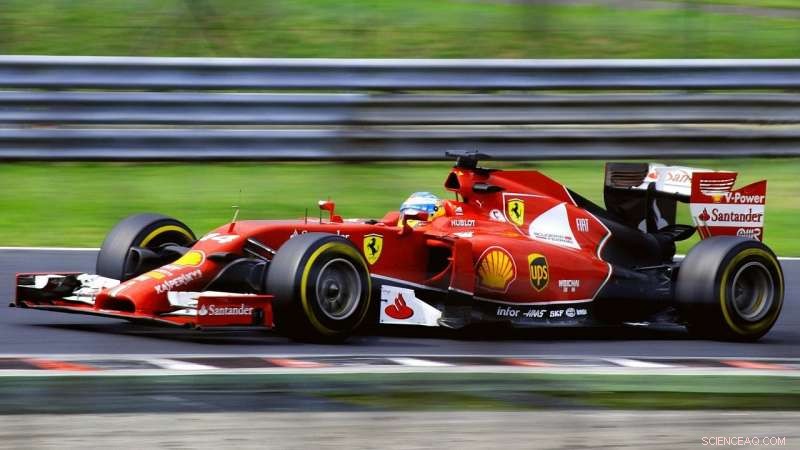
A team of researchers with Korea Advanced Institute of Science and Technology, the U.S. Treasury and the European School of Management and Technology has found via data analysis that Formula 1 race car drivers are more likely to crash if they are racing against an opponent who is similar in age and driving prowess when driving under safe conditions. In their paper published in the Proceedings of the National Academy of Sciences, the group describes their study of racing data and what they learned about race car driver behavior under escalating competitive conditions.
Race car driving is an intense sport—drivers push their cars in excess of 200 mph while competing against other skilled drivers, which, despite recent technology advances, still represents quite a risk—drivers are still killed in wrecks sometimes. But the researchers wanted to determine the factors that lead to actual crashes. To find out, they obtained Formula 1 racing data for the years 1970 to 2014, which covered 732 races and 355 drivers, and analyzed it looking for patterns. One pattern is the heightened risk of a crash during good weather when drivers are similar in age and stature (when both are considered to have similar driving skills as noted by their ranking). A notable example would be the rivalry between Lewis Hamilton and Nico Rosberg—despite being teammates, the two have managed to rack up an impressive number of collisions, often with one another.
The work was based on what those in the social sciences describe as the structural equiveillance theory—in which those with similar characteristics engage in heightened competitive conflict. An extreme example, they note, would be Mike Tyson biting off Evander Holyfield's ear in the middle of a highly promoted bout. When such behavior is present in racing, the end result can often be a collision as drivers make increasingly risky moves in attempting to best an opponent. But interestingly, they found, only when the weather is good, offering safe driving conditions. Presumably, all of the drivers on a course in poor weather are much more focused on avoiding a weather-related crash.
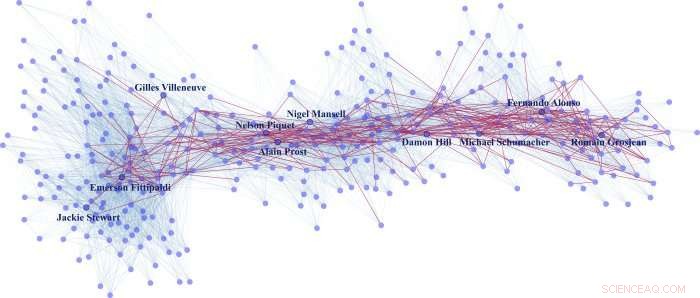
Drivers' competitive network and collisions. Nodes are drivers. Nodes encircled in black are labeled by name. Edges denote joint competition in at least one race. Red edges connecting nodes indicate that the two drivers collided at least once. Using Fruchterman-Reingold, nodes are generally proximate to the extent that their average structural equivalence (over all races, from 1970 to 2014) is high. Credit: Piezunka, Lee, Haynes, and Bothner 2018
© 2018 Phys.org