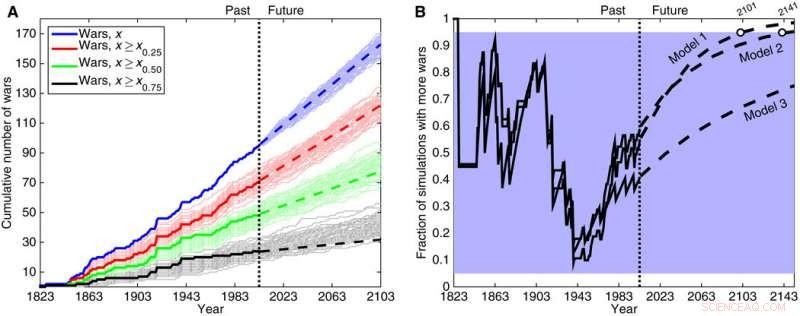
(A) Simulated accumulation curves for wars of different sizes under a simple stationary model (model 1; see main text), overlaid by the empirical curves up to 2003 (dark lines) and linear extrapolations of the empirical postwar trends (the long peace) for the next 100 years (dashed lines). Quartile thresholds are derived from empirical severity data. (B) Fraction of simulated conflict time series that contain more large wars (x ≥ x0.75) than observed in the past or than expected in the future relative to a linear extrapolation of the postwar tend. Years at which the postwar trend (the long peace) becomes statistically unlikely under a stationary model, relative to 95% of simulated time series, are marked with open circles. Credit: Science Advances (2018). DOI: 10.1126/sciadv.aao3580
Aaron Clauset, an assistant professor and computer scientist at the University of Colorado, has taken a calculating look at the likelihood of a major war breaking out in the near future. In an article published on the open access site Science Advances, he describes his analysis of the history of human warfare using a large historical dataset, and offers his opinion on whether we are in the midst of a new era of peace, or if it just seems that way.
The world has not seen a major war since the end of WWII, over 70 years ago—a timespan that has some convinced that the human race has finally recognized the futility of large wars and is evolving into a more peaceful future. After all, we now live in an age of widespread democracy along with the knowledge of likely mutual destruction, or perhaps nuclear winter—a rather strong argument against war. But Clauset wondered if such a view based on too little information. To find out, he used data from the Correlates of War Project, a database that holds a massive amount of information regarding wars of the past several hundred years, to see if the current period is an anomaly, or just a blip on history's radar screen.
Clauset used the data to gauge statistical fluctuations over time, looking for trends. He also built several computer models to replay wars from the past and the time periods that followed such wars. He sought periods when people avoided major wars for long periods after prolonged conflicts, and whether other large wars occurred after such peaceful intervals. Sadly, he found that they did—and such wars have occurred often enough to indicate that the current peaceful period is not that rare—there is nothing special about it, he concludes. He therefore suggests that there is nothing in our past or present that might offer a reason to believe that we can avoid such conflicts in the near future. But, he also notes, if the current peaceful interval continues for perhaps another century, we might have a compelling argument for claiming we have really changed.
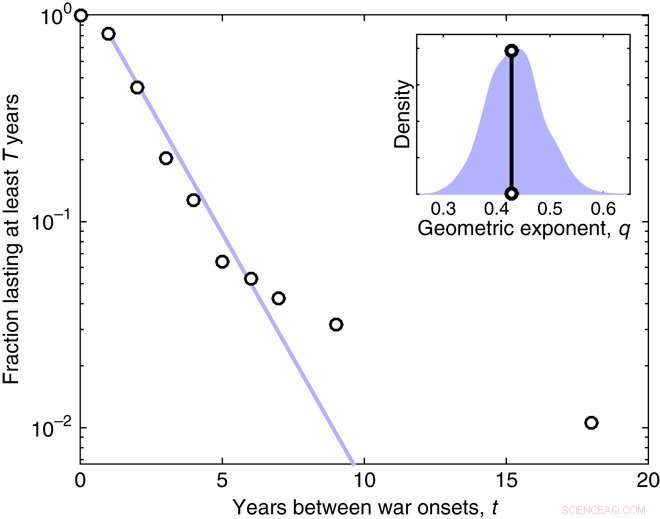
Times between interstate war onsets, 1823–2003. The maximum likelihood geometric model (solid line) is a plausible data-generating process of the empirical delays (Monte Carlo, pKS = 0.13 ± 0.01), implying that the apparent discontinuity at t = 5 is a statistical artifact. Inset: Bootstrap distribution of maximum likelihood parameters Pr, with the empirical estimate (black line). Credit: Science Advances (2018). DOI: 10.1126/sciadv.aao3580
© 2018 Phys.org