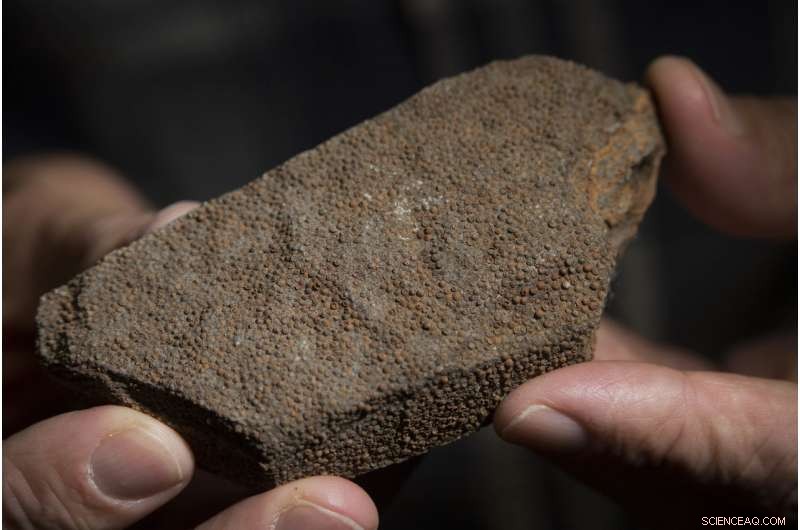
Rogenstein oolite from Germany. Credit: Lannon Harley, ANU
A new study led by The Australian National University (ANU) has found that some of the building blocks of the Pentagon and Empire State Building were made by microbes that lived up to 340 million years ago, predating the dinosaurs.
The material, known as oolitic limestone, is a popular building material around the world and is almost completely made of millimetre-sized spheres of carbonate called ooids.
Co-researcher Dr Bob Burne from ANU said the new study found that ooids were made of concentric layers of mineralised microbes, debunking the popular 'snowball theory' that ooids were formed by grains rolling on the seafloor and accumulating layers of sediment.
"We have proposed a radically different explanation for the origin of ooids that explains their definitive features," said
Dr Burne from the ANU Research School of Earth Sciences. "Our research has highlighted yet another vital role that microbes play on Earth and in our lives."
Different types of oolitic limestones have formed in all geological periods and have been found around the world, including in the United States, the United Kingdom, Germany, the Bahamas, China and at Shark Bay in Western Australia.
Dr Burne said humans had known about and used oolitic limestone since ancient times.
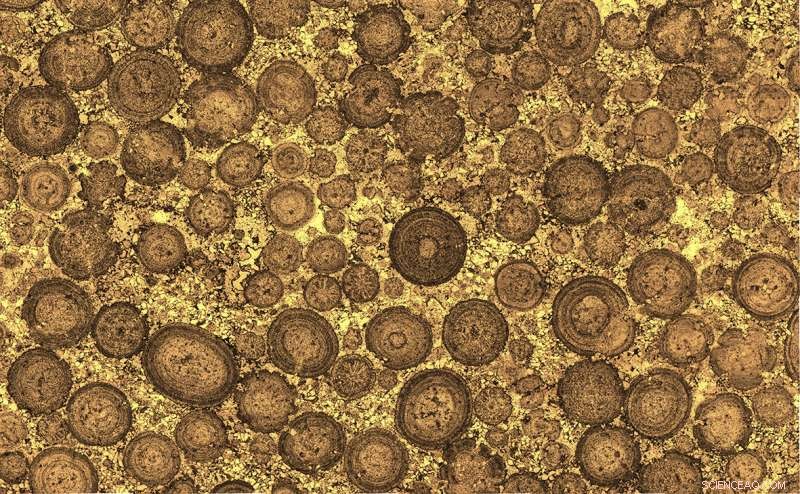
Cross section of the ooids inside Rogenstein oolite. Credit: ANU
"Many oolitic limestones form excellent building stones, because they are strong and lightweight," he said.
"Mississippian oolite found in Indiana in the US has been used to build parts of the Pentagon in Virginia and parts of the Empire State Building in New York City.
"Jurassic oolite in England has been used to construct Buckingham Palace and much of the City of Bath, the British Museum and St Paul's Cathedral."
Professor Murray Batchelor from ANU led an international team of researchers on the study, which is published in Scientific Reports.
"Our mathematical model explains the concentric accumulation of layers, and predicts a limiting size of ooids," said Professor Batchelor from the Research School of Physics and Engineering and the Mathematical Sciences Institute at ANU.
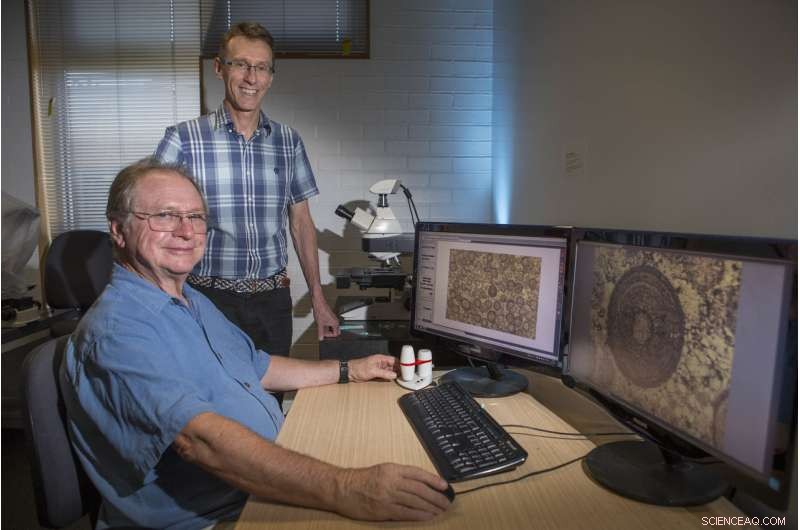
Dr Bob Burne (sitting) and Professor Murray Batchelor. Credit: Lannon Harley, ANU
"We considered the problem theoretically using an approach inspired by a mathematical model developed in 1972 for the growth of some brain tumours."
Professor Batchelor said the research findings could help better understand the effects of past climate change.