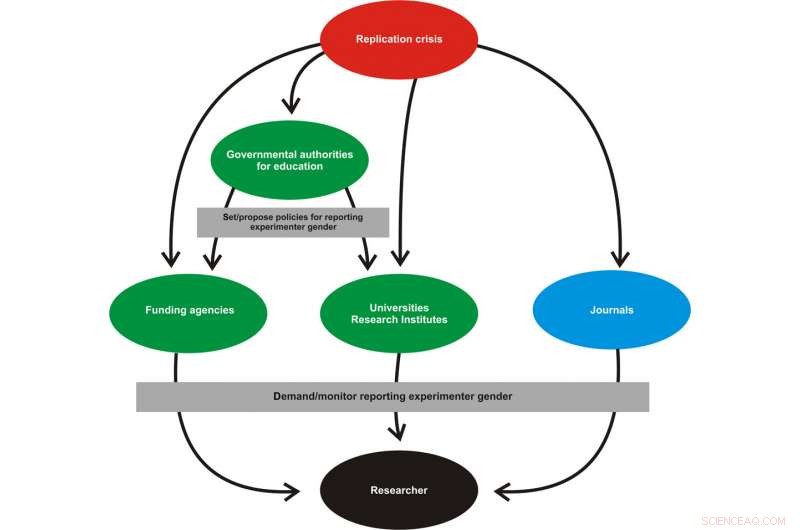
Flowchart identifying the key players responsible for policy changes within science. As shown, the initiation of a crisis can induce change through several mechanisms. Prominent among these are changes in policy recommendations from government funding sources, in addition to policy changes at journals, universities, and independent funding agencies. Credit: Science Advances (2018). DOI: 10.1126/sciadv.1701427
A trio of researchers at Uppsala University in Sweden is calling for a change in how researchers self-report in research papers. Specifically, they are suggesting publishing the gender of the researcher, because gender can impact the outcome of a research effort. In their Review paper published on the open access site Science Advances, Colin Chapman, Christian Benedict and Helgi Schiöth suggest that revealing gender as part of paper publication could improve the reproducibility problem.
According to the authors, there is a replication crisis in the work being done by researchers and documented in scientific journals. They note further that some research has uncovered the source of the problem, but there is still a lot of work to do. They believe one part of the problem is the failure of the research community to address the problem of gender impact on research results, particularly those involved in three areas of human research: mind, body and behavior. While the topic might sound sexist, or even perhaps a swipe at female researchers, the authors note that skewing can go both ways.
Prior research has shown, for example, that if a female researcher administers an IQ test to volunteers, the results will skew higher than if they are administered by a male researcher. There is also evidence indicating that male volunteers given a drug to test efficacy at pain reduction, will report less pain if the researchers administering the drug are female than if they are male. Similar discrepancies exist in problem solving and behavioral studies. And, the authors note, it is not all in our minds. Even lab animals have been found to respond differently to test medications or in behavioral studies depending on administration by male or female researchers.
For these reasons, the authors argue that the time has come for authors of research papers to include the gender of the researchers as part of the author information. That way, if another team wishes to replicate the results of an experiment, they might have better luck doing so. They even go so far as to suggest that journals that publish scientific papers require gender to be included as a standard part of research reporting.
© 2018 Phys.org