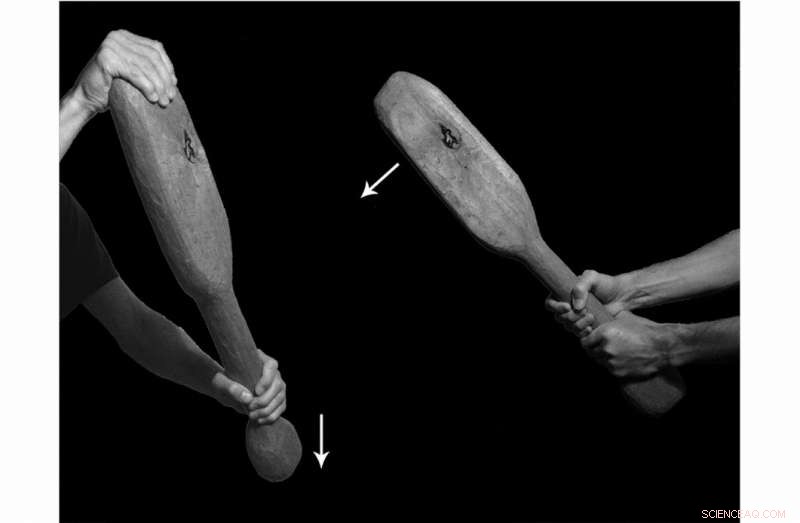
The hand positions used to administer the two types of blow: left) the pommel strike; right) the double-handed strike. Arrows indicate direction of swing . Credit: Meaghan Dyer
(Phys.org)—A team of researchers with the University of Edinburgh has found evidence that the "Thames Beater" was a weapon that could be used to kill another person—perhaps at times, with a single blow to the head. In their paper published in the journal Antiquity, the group describes experiments they conducted to learn more about the lethality of the weapon.
Some time ago, archaeologists pulled a wooden club from a waterlogged part of the north bank of the River Thames—after dating it back to approximately 3530-3340 B.C., they subsequently dubbed it the "Thames Beater" because it had clearly been used by one person to beat another person during the Neolithic period. In this new effort, the researchers sought to learn more about the damage the weapon could cause.
Because they did not have access to an original club (only one real one has been found), and because they could not bash actual humans, the team fashioned their own clubs modeled after the original Thames Beater. To replicate the human head, they used a model that had been designed for military ballistic testing. Skulls were made of polyurethane which were filled with gelatin and wrapped with a rubber skin. The researchers then enlisted the assistance of a 30-year-old male volunteer to serve as a combatant wielding a Thames beater. He bashed the head of the model as hard as if he were fighting for his life. Upon examining the results, the researchers found that the Thames beater was, indeed, a weapon that could be used to crack the skull of a human being and kill them.
The researchers than compared the fractured fake skulls with real ones that had been dug up from Neolithic graveyards and found at least one that looked very similar, suggesting that the person who had done the damage was likely using a Thames beater. Taken together, the evidence suggests the club was more lethal than has been thought. It also creates a better picture of what Neolithic violence was like, the researchers add, noting that the club would likely have been used only in scenarios in which one person was very clearly bent on killing another.
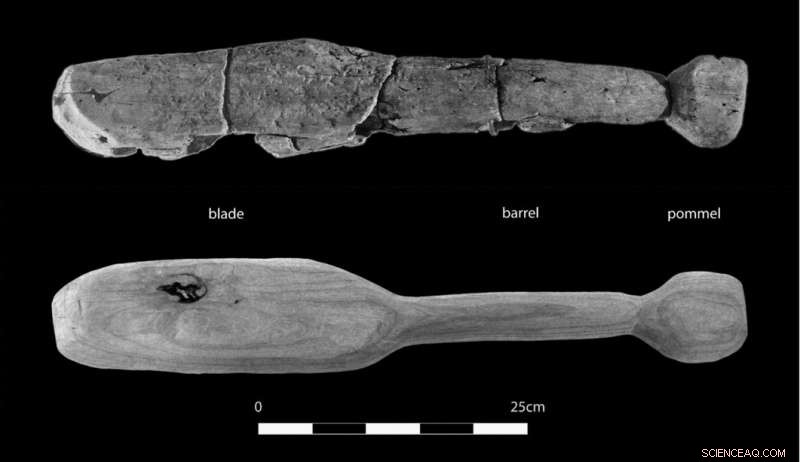
The Thames Beater (top) and the replica club used for experimentation (bottom) with the blade, barrel and pommel labelled . Credit: Meaghan Dyer
© 2017 Phys.org