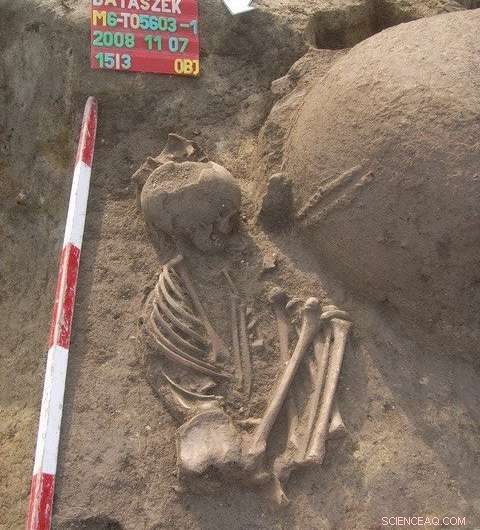
An Early Neolithic grave from Bátaszék (Hungary), which was also part of the DNA analyses. Credit: Anett Osztás
(Phys.org)—A large international team of researchers has found that Neolithic hunter-gatherers living in several parts of Europe interbred with farmers from the Near East. In their paper published in the journal Nature, the team describes comparing DNA from several early groups in Europe and evidence of interbreeding.
The Neolithic period, often described as the New Stone Age, was a period of human history from approximately 15,000 BCE to 3,000 BCE. It was a time defined by the development of settlements and the refinement of tools and the arts. Prior research has shown that people living in what is now Germany, Hungary and Spain were mostly hunter-gatherers during the early Neolithic period, but were "replaced" by farmers moving in from the Near East (Anatolia). In this new effort, the researchers suggest that interbreeding between the two groups led to the decline of the hunter-gatherers. The end result is that most modern Europeans are descended from the Near East immigrant farmers, but have remnants of hunter-gatherer DNA.
To learn more about the early history of humans in Europe, the researchers obtained and analyzed 180 DNA samples of people from early Hungary, Germany and Spain dating from between 6,000 and 2,200 BCE. They used data from the DNA analysis to create a mathematical model, which was used to build a simulation of population interactions in the areas of study.
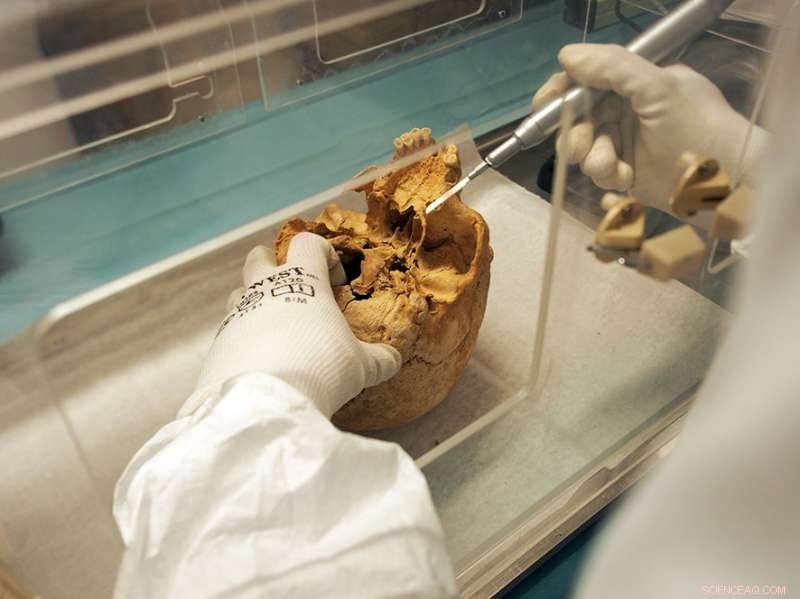
Sampling of petrous bone from a human skull. Credit: Balázs G. Mende
The researchers found that there was a lot more breeding going on between the two groups than has been thought. They found that as the farmers moved in, interbreeding began almost immediately. It continued for approximately the next several hundred years at all of the sites under study, though the team reports a more rapid pace in Spain and Germany than in Hungary.
The researchers note that their findings make sense logically, as well—it would seem far more likely that contact between the two groups would result in interbreeding, rather than one group simply out-reproducing the other to the point that the original group simply disappeared.
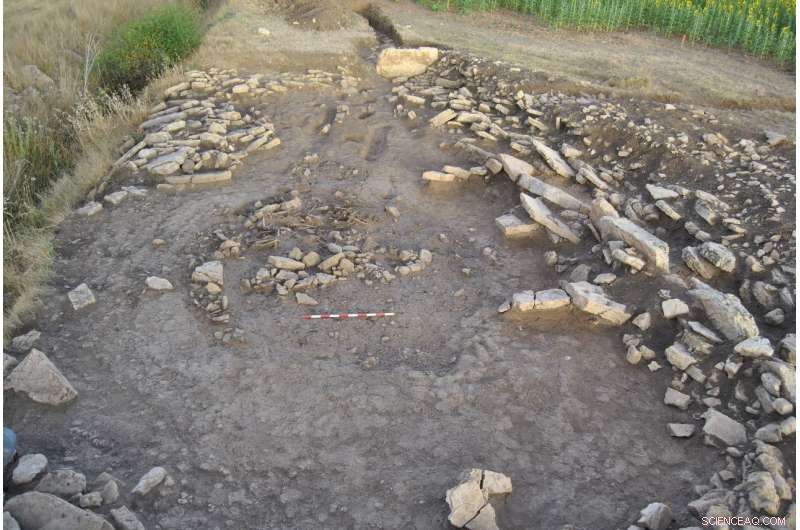
Middle Neolithic Collective grave of La Mina, Spain, excavation situation Credit: Manolo Rojo Guerra
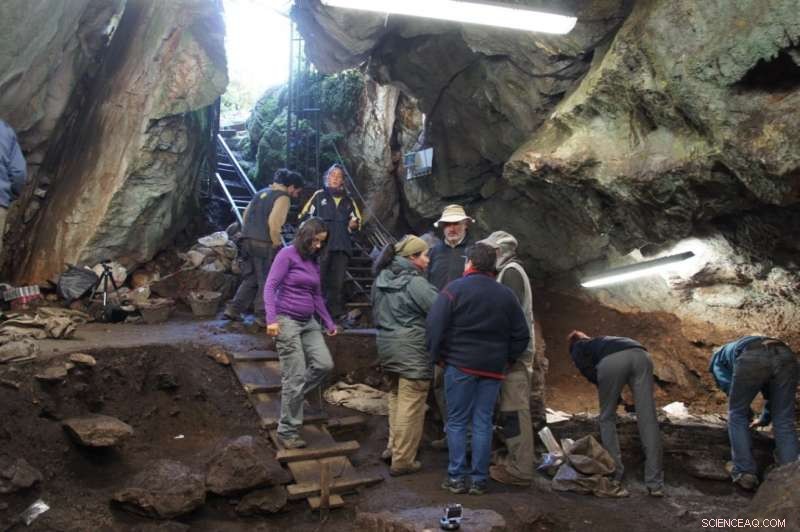
Cave Els Trocs in the Spanish pyrenees with Early Neolithic burials, discussion between members of the excavation group. Credit: Kurt Werner Alt
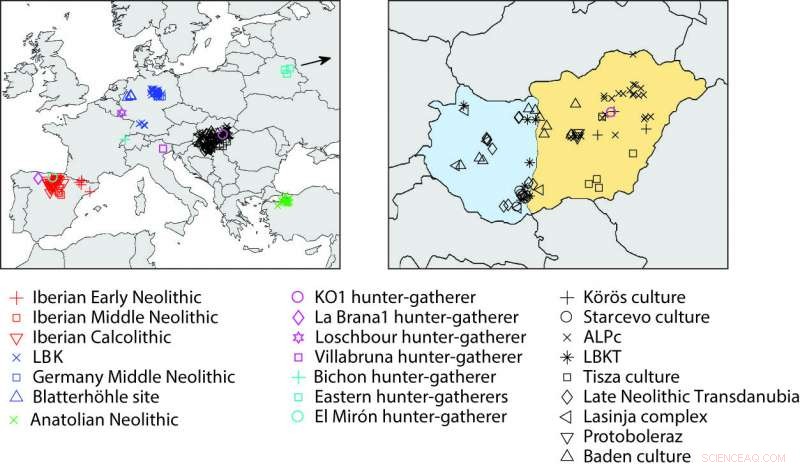
Geographic locations of the samples analyzed in the study "Parallel palaeogenomic transects reveal complex genetic history of early European farmers" with a close-up of Hungary (based on figure 1a-b from Nature, Lipson/Szécsényi-Nagy et al. 2017, http://dx.doi.org/10.1038/nature24476). Credit: Nature, Lipson/Szécsényi-Nagy et al. 2017.
© 2017 Phys.org