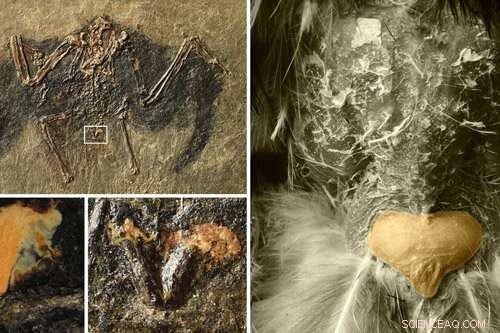
A fossil preen gland in a 48-million-year-old bird, showing the fossil gland in detail as it was found before sampling and after preparation. The creamy white material is fossilised preen gland oil/wax. Right hand side: Modern bird with the preen gland prepared out from a modern Sickle-Billed Vanga (artificially coloured to highlight the preen gland). Credit: University of Bristol
(Phys.org)—A team of researchers from the U.S., Ireland, Germany and the U.K. has found evidence of preservation of a fatty oil gland from a 48-million-year-old fossilized bird. In their paper published in Proceedings of the Royal Society B, the group describes where the fossil was found, how it was tested and what their findings might mean for other fossilized bird remains.
Finding soft tissue preserved along with fossilized remains of long-dead creatures is extremely rare—tissue usually decomposes quite quickly, leaving modern scientists to make educated guesses about the nature of long-gone skin and organs. But sometimes, conditions are just right for preservation of soft tissue, as the team working at the famed Messel Pit in Germany discovered when studying a fossilized bird. Upon examination of the remains, the team discovered an object near where its tail feathers had once been, which looked similar to the uropygial gland in modern birds—it produces an oil for feather preening. Preening with an oily material waterproofs feathers, and in some cases, can help birds ward off bacteria and fungi.
The team studied the object using pyrolysis gas chromatography-mass spectrometry to better understand its chemical composition and found that it was unlike those of the bird's other fossilized parts or the oily material in which the bird had been found. Instead, it very closely resembled the chemical makeup of modern uropygial glands. Taken together, the team reports, all signs point to the object representing an example of soft tissue surviving over the course of millions of years.
The finding, the researchers also note, suggests that it might be possible that feathered flightless dinosaurs might have engaged in preening, as well. And they further note that it might be wise to take another look at other fossilized bird samples in museums to see if they have a preserved gland, as well.
The bird, which the team describes as approximately the size of a modern wren, appears to be of an unidentified species, possibly one belonging to the Messelirrisoridae family. It had a long beak and lived in a forest in what is now central Germany. The researchers suggest it probably spent its life among the trees rather than foraging on the ground.
© 2017 Phys.org