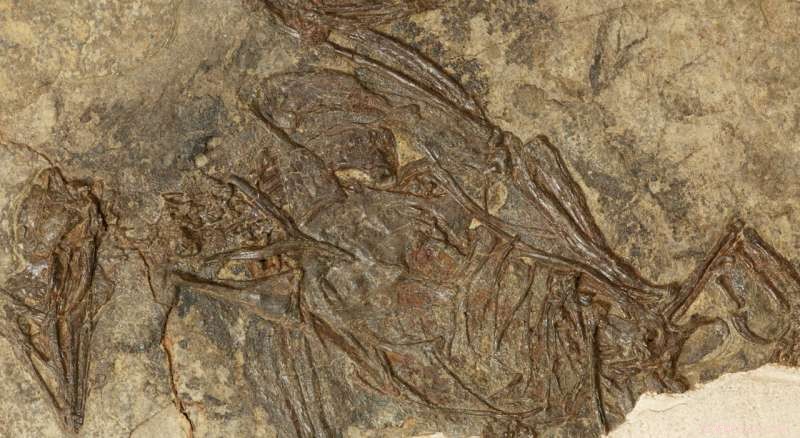
Pterygornis. Credit: W. Gao (Institute of Vertebrate Paleontology and Paleoanthropology, Beijing).
(Phys.org)—A trio of researchers with the Key Laboratory of Vertebrate Evolution and Human Origins of Chinese Academy of Sciences has found evidence that pushes back the earliest example of fused bones in birds by approximately 40 million years. In their paper published in Proceedings of the National Academy of Sciences, Min Wang, Zhiheng Li and Zhonghe Zhou describe their study of the fossilized remains of a bird dated to approximately 120 million years ago.
In order for birds to evolve from land or tree dwelling animals into creatures that can fly, many changes had to occur—they had to become lighter while maintaining a strong skeleton. One of the ways this occurred was through fusion of bones, such as fingers into wingtips, while many other bones were simply lost to evolution. Until now, the consensus among scientists has been that such changes did not occur until just before land-based dinosaurs became extinct. But now, new evidence by the team in China suggests that the time frame will have to be pushed back approximately 40 million years—the bird now represents the oldest known example of fossilized remains showing bone fusion of its major parts.
The skeletal remains they were studying were of a bird, Pterygornis dapingfangensi (an Enantiornithe) that once lived in what is now northeastern China. It represents only the second one of its kind ever found. The researchers report that it was in very good condition, so studying it was easy. They report also that the bird very clearly had fused hands and pelvic girdle. More specifically, the fusion was seen in the ilium, the alular-major metacarpals, the ischium and in the pubis pelvis bones. They note that such fusions have rarely been reported with birds of the Early Cretaceous and that the birds appeared to have followed a growth pattern similar to that of modern birds.
The finding fills in some of the blanks that have made it difficult to follow the transition of land animals to birds due to a dearth of fossilized evidence. With the finding of the new specimen, more details about bone fusion and the evolutionary history of flight in animals are emerging.
© 2017 Phys.org