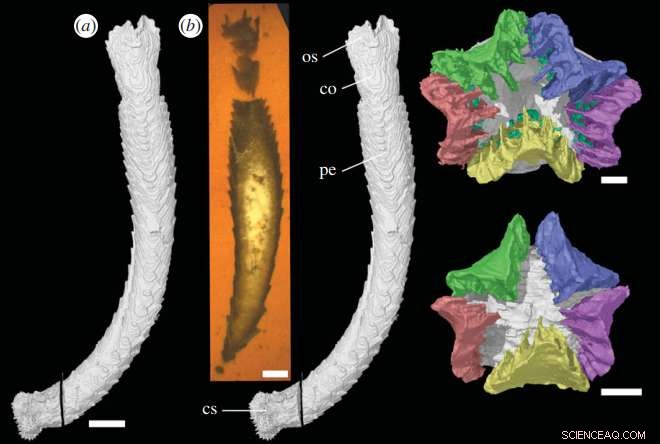
Heropyrgus disterminus. Credit: (c) Proceedings of the Royal Society B: Biological Sciences (2017). DOI: 10.1098/rspb.2017.1189
(Phys.org)—A team of researchers from the U.K. and the U.S. has identified the remains of a 430-million-year-old extinct echinoderm found in a fossil bed in Herefordshire, England. In their paper published in Proceedings of the Royal Society B, the group explains their study of the specimen, which they note is the first example ever found of an extinct echinoderm with preserved tube feet. They have named it Heropyrgus disterminus.
Though the phylum is not well known by most people, examples of those in its five extant classes include sea stars, sea urchins and sea lilies. What sets them apart, aside from a five-fold symmetry, are the tube-like protrusions that extend from their undersides. The tubes are used for a wide variety of purposes including feeding, oxygen exchange and locomotion. Most echinoderm fossils that have been found have missing tube structures due to their delicate nature, leaving researchers to make their own assumptions. In this new find, the researchers found the tubes to be intact.
Scientists in the field have long suspected that ancient echinoderms had tube-like structures similar to those that are seen today, but have found little evidence to back them up. The specimen involved in this new effort required special handing after removal from the fossil bed because it was embedded in volcanic ash. It was the ash, of course, that preserved the tube structures—sealing the creature in an airtight bed while still alive.
To study the fossil, the researchers used a grinder to remove the ash and periodically took cross-sectional pictures of the sample as they went. In so doing, they were able to build a 3-D image of the fossil as a whole.
The team reports that rather than existing as a flat creature, like most modern echinoderms, H. disterminus had a cone-shaped body and was approximately 3 cm in length. It also had five plates covering its body, which also held the tube feet. They note that the internal plumbing had not been preserved, but suggest the tubes were likely used for eating and gas exchange. They note that unlike modern echinoderms, the tube feet of H. disterminus were situated in dual sets in a unique arrangement.
© 2017 Phys.org