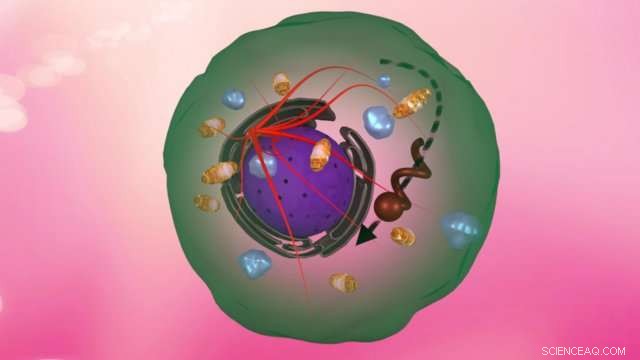
Schematic of the nanorobot moving through a living cell. Credit: Advanced Materials (2018). DOI: 10.1002/adma.201800429
A team of researchers at the Indian Institute of Science in Bangalore has developed a type of nanomotor that can be guided inside of a living cell using an external magnetic field. In their paper published in the journal Advanced Materials, the group describes their nanomotor, how it works, and possible uses for it.
As medical scientists continue to look for new ways to study living beings, many are studying the possibility of putting miniature objects inside of a living organism that can carry drugs or perform actions such as blocking blood vessels that feed tumors. Some have taken the science even further by creating objects small enough to fit inside a single cell. Such objects could conceivably carry drugs directly to individual parts of a cell. But, as the researchers with this new effort report, prior efforts have resulted in disruption to the cell, preventing the use of such devices. They report that they have now developed a nanomotor that can be guided to desired locations inside of a cell without causing disruptions.
The nanomotor was made mostly of silica, the team reports, but was covered with a very thin iron film to allow for control by magnetism. The nanomotor is shaped like a corkscrew, which means when it spins, it moves forward. A spinning external coil that generated a magnetic field induced the nanomotor to spin. Slight changes in the angle of the magnetic field caused the nanomotor to turn in desired directions.
The researchers made several of the nanomotors in different sizes and tested them in different types of cells, some of which were from cancerous tumors. They report that the smallest (250-nanometer) nanomotors offered the most flexibility for movement inside of the cells. To prove just how well they could steer a nanomotor inside of a cell, the team directed one along a path that outlined the letters "M" and "N." They acknowledge that their tiny motors are still in the early stages of development, but suggest their design is likely to lead to applications in drug delivery, or even nano-surgery.
© 2018 Medical Xpress