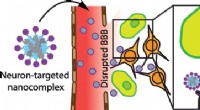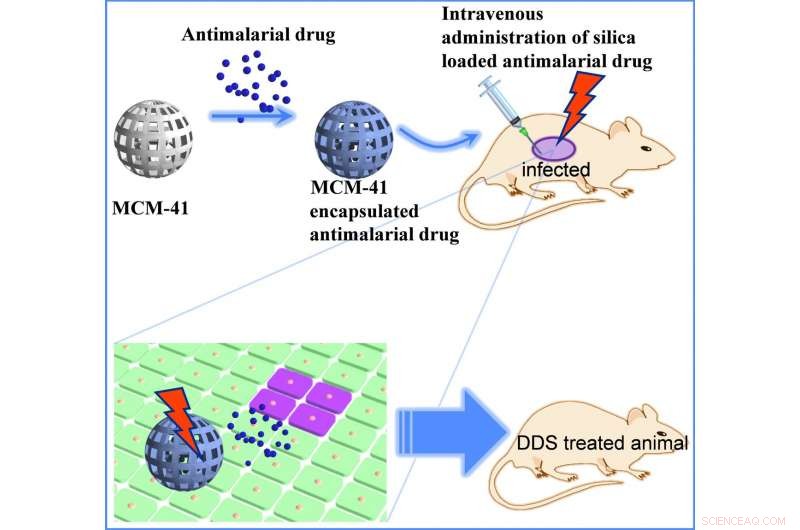
Kumamoto University researchers found that using MCM-41 as a drug delivery system for malaria treatment produced a highly efficient treatment in animals. Clinical trials are planned in the near future. Credit: Shinya Hayami
Drug delivery systems (DDSs) control the dosage and timing of drugs. Numerous DDS studies have been conducted, but most have focused on treatments for cancer. New research from Kumamoto University uses a DDS to treat malaria.
The existing treatment for malaria is taken orally and has three main problems: (1) most antimalarial drugs are broken down in the stomach, (2) the drugs have strong side effects, and (3) the medicine stays in the body for only a short time. These issues have resulted in malaria treatments that were not particularly effective.
MCM-41 is a porous silica material with a pore size of two to 30 nm. It can incorporate drugs into its pores, which makes it a useful material for DDS applications. A research group headed by Prof. Shinya Hayami from Kumamoto University, Japan, believed that MCM-41 could be used as a DDS for antimalarial drugs. To test their theory, they created a new DDS by combining the antimalarial drugs artesunate and quinine with MCT-41 and performed in vitro and in vivo experiments. They found:
"Using this DDS for antimalarial drugs has introduced a new possibility for highly efficient malaria treatment for the first time," said Professor Shinya Hayami. "We expect that it will be put to practical use in areas where malaria treatment is still necessary. Now, we are planning to develop clinical trials for antimalarial drugs as well as new DDSs for other drugs like anti-HIV medications."