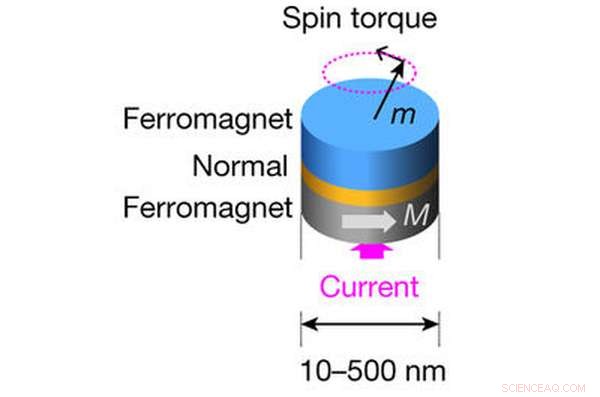
Schematic of a spin-torque nano-oscillator, consisting of a non-magnetic spacer (gold) between two ferromagnetic layers, with magnetization m for the free layer (blue) and M for the fixed layer (silver). A current injected into the oscillator induces magnetization precessions of m. For our experiments we used a nano-oscillator with a diameter of 375 nm; however, diameters of 10–500 nm are possible. Credit: Nature (2017). DOI: 10.1038/nature23011
(Phys.org)—A team of researchers with members from France, Japan and the U.S. has created a nanoscale magnetic device that mimics the behavior of neurons and can be used to recognize human audio signals. In their paper published in the journal Nature, the team describes how they built their device, how it works and how accurate they found its results. Frank Hoppensteadt with the Courant Institute of Mathematical Sciences offers a News & Views piece on the work done by the team and outlines the ideas behind neuromorphic (brain-like) computers and how some of them are being created.
As their name implies, neuromorphic computers are computing devices that work by mimicking the way the human brain works—in such systems, researchers create devices meant to mimic neurons, synapses, etc. In this new effort, the researchers built such a device and used it to recognize human audio signals. Notably, such devices are typically analog rather than digital and are expected to offer some advantages over traditional computers (reduced energy need, trainability and higher data transfer speeds) if they can be developed. In this new effort, the researchers built a nanoscale neuromorphic computer with 400 neurons arranged in an array and placed on a computer chip.
The neurons were represented by tiny three-layer pillars—a non-magnetic spacer between two ferromagnetic layers. A continuous electric current induced direct magnetization at the top of the neuron, and a secondary current caused the magnetization to oscillate in a stable way. To use the array as a computing device, the researchers spoke a single-digit number such as "one" aloud into a microphone, which fed the sound to a digital processor that converted it to an electrical signal. The electrical signal was then fed to the neuron-mimicking chip, which the researchers referred to as a reservoir. Another digital computer read the oscillations of the neurons, analyzed them, and then to translated the result to a human-recognizable form, such as displaying the word "one" on a video screen. In testing the device with multiple voices, the team found it to be 99.6 percent accurate.
The device is clearly rudimentary, and was built purely for research purposes, but it does demonstrate that neuromorphic computers are more than simple flights of fancy—they may very well augment future computers, offering new ways to process information.
© 2017 Phys.org