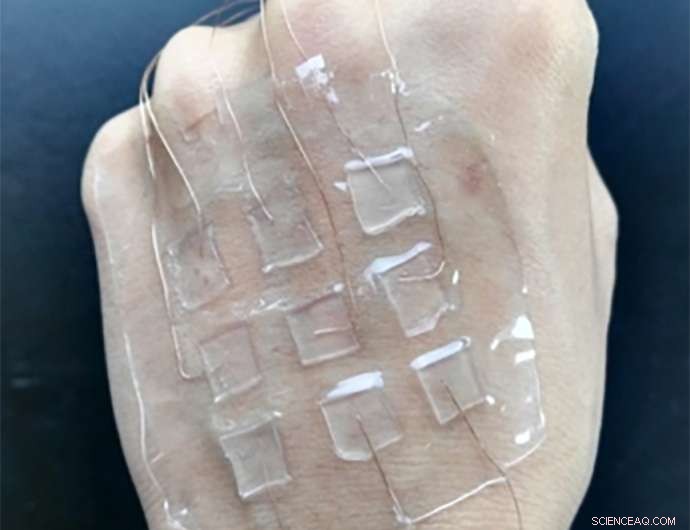
A transparent electronic skin for tactile sensing. Credit: Xiong Pu
(Phys.org)—A team of researchers with the National Center for Nanoscience and Technology in China has developed what it is calling a skin-like triboelectric nanogenerator (STENG). In their paper published in the journal Science Advances, the group describes the nanogenerator they built and offer suggestions for its use.
Prior research led to the construction of TENG devices that generate electricity by pressing materials together and taking them apart, creating an electrostatic charge. In this new effort, the researchers put an S in front of the name of their TENG device to highlight its similarity to human skin.
To make the new device, the group mixed an elastomer with an ionic hydrogel to create a material that is both flexible and nearly transparent. Unlike other TENG devices, the elastomer can be used as the layer that is electrified while the hydrogel can work as the electrode. This allowed for much better stretching abilities—the team reports a 1000 percent improvement over other TENGs.
The researchers report that the material is also nearly clear, allowing 96.2 percent of light to pass through it—this, they suggest, makes it useful for devices that require transmission of optical data. The nanogenerator was able to continue functioning properly in temperatures up to 30° C, and with humidity as high as 30 percent. Testing showed that the material was capable of producing up to 145 volts and had a power density of 35 milliwatts per square meter when configured as an open circuit. The team notes also that all of the materials used to make the device are inexpensive, light and readily available.
As an end product, the STENG could be used to adhere to skin or clothing to generate electricity powering small devices such as phones or music players. Because it can be made in a variety of shapes, it could also be used in other configurations, such as inside of a shoe, where it could generate electricity by taking advantage of the foot pressure against the insole. The researchers note that it could also potentially be used in applications that involve tapping, or even in self-powered robots.
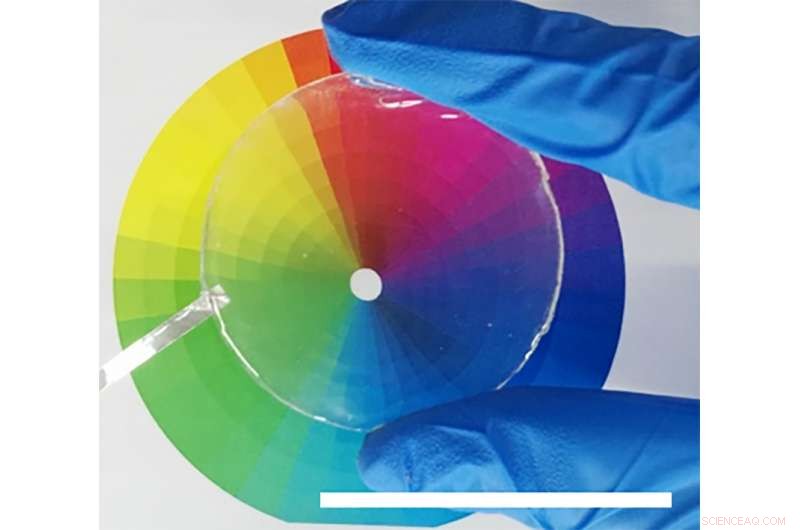
A circular soft and transparent triboelectric nanogenerator. Credit: Xiong Pu
© 2017 Phys.org