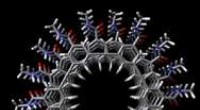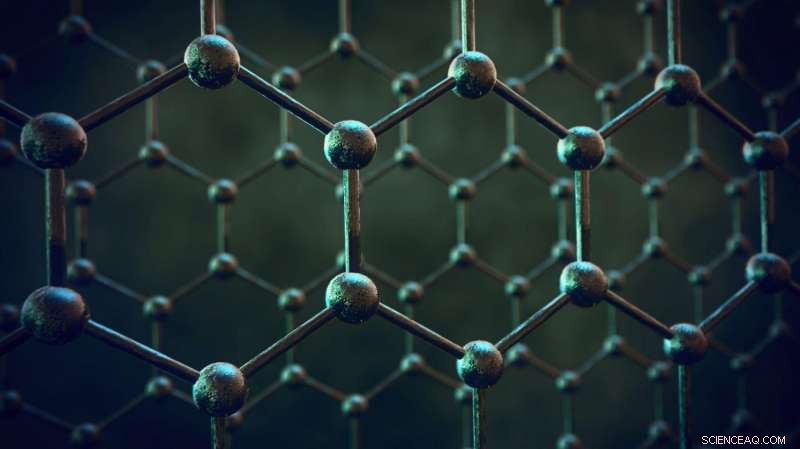
This visualisation shows layers of graphene used for membranes. Credit: University of Manchester
(Phys.org)—A team of researchers affiliated with institutions in the U.S., China and the Kingdom of Saudi Arabia has developed a new type of porous graphene electrode framework that is capable of highly efficient charge delivery. In their paper published in the journal Science, the group describes how they overcame traditional conflicts arising between tradeoffs involving density and speed to produce an electrode capable of facilitating rapid ion transport. Hui-Ming Cheng and Feng Li with the Chinese Academy of Sciences offer a Perspective piece on the work done by the team in the same journal issue, and include some opinions of their own regarding where such work is likely heading.
In a perfect world, batteries would have unlimited energy storage delivered at speeds high enough to power devices with unlimited needs. The phaser from Star Trek, for example, would require far more power and speed than is possible in today's devices. While it is unlikely that such technology will ever come about, it does appear possible that batteries of the future will perform much better than today, likely due to nanostructured materials—they have already shown promise when used as electrode material due to their unique properties. Unfortunately, their use has been limited thus far due to the ultrathin nature of the resulting electrodes and their extremely low mass loadings compared to those currently in use. In this new effort, the researchers report on a new way to create an electrode using graphene that overcomes such limitations.
The electrode they built is porous, which in this case means that it has holes in it. Those holes, as Cheng and Li note, allow better charge transport while also offering improved capacity retention density. The graphene framework they built, they note, offers a superior means of electron transport and its porous nature allows for a high ion diffusion rate—the holes force the ions to take shortcuts, reducing diffusion.
Cheng and Li suggest the new work is likely to inspire similar designs in the search for better electrode materials, which they further suggest appears likely to lead to new electrodes that are not only practical, but have high mass loadings.
© 2017 Phys.org