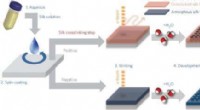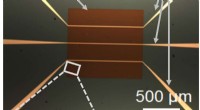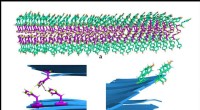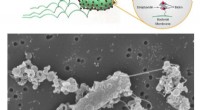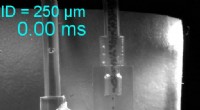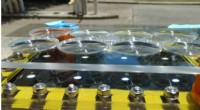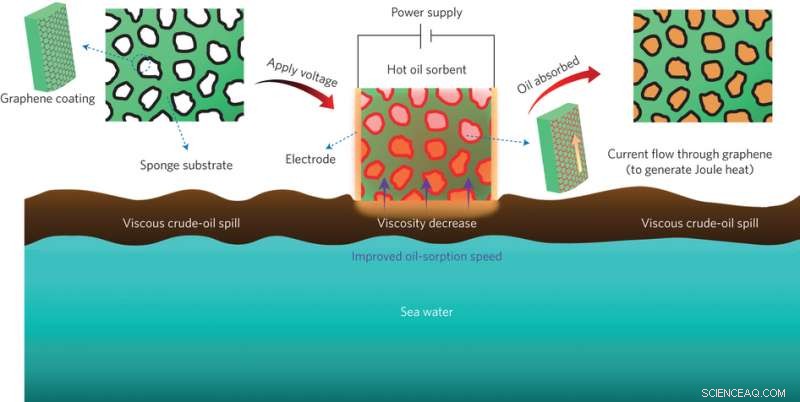
Schematic illustration of Joule-heated GWS used to clean-up a viscous crude-oil spill. Credit: (c) Nature Nanotechnology (2017) doi:10.1038/nnano.2017.33
(Phys.org)—A team of researchers with the University of Science and Technology of China has found a way to make sponges used to clean up oil spills in the ocean work better when soaking up heavy crude oil. In their paper published in the journal Nature Nanotechnology, the team describes how they wrapped polymeric sponges in graphene nanoribbons and then applied an electric current to cause the sponge to absorb the normally thick oil. Despina Fragouli and Athanassia Athanassiou with Istituto Italiano di Tecnologia in Italy offer a News and Views piece on the work done by the team in the same journal issue.
Oil spills are, of course, a serious problem with extracting oil from the ground or from beneath the ocean and shipping it for use in another location. Oil spills cause a lot of damage to the local ecosystem that can last for many years. In recent years, oil spills have happened less often, but when they do occur, they are worse than before due to the type of oil that is spilled. As medium and light crude oil reserves have been depleted, oil companies have turned to extracting heavy oil, which is more difficult to work with because it is so thick it does not flow very well—it also has low sorption, which means it is not pulled into sponges like other oils when it is spilled. In this new effort, the researchers have found a way to make conventional sponges better at pulling in such oils when leaks occur.
The new technique involves covering traditional sponges with graphene nanoribbons and then applying a small amount of current causing it to heat up by approximately 285 °C—prior research has shown that functional nanomaterials can make traditional porous materials better at removing low and medium viscosity oils from water. Using graphene as the nanomaterial takes advantage of the material's Joule heating properties, which warms the sponge and oil around it making the oil thinner and thus more able to be pulled into the sponge. Once the sponge absorbs as much as is possible, it is squeezed mechanically to remove the oil—that means that it can be reused several times, another advantage of the design. The team reports that the recovery rate for their sponge is 29 times that of non-heated sponges.
© 2017 Phys.org