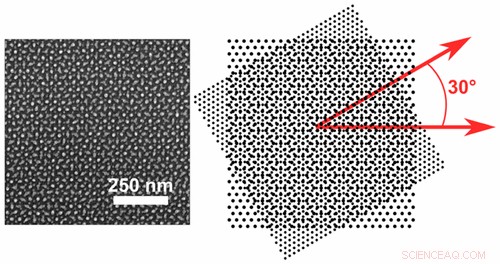
Credit: ACS Nano (2017). DOI: 10.1021/acsnano.7b00322
(Phys.org)—A team of researchers at the University of Alberta has developed a way to create moiré superstructures using block copolymers. In their paper published in the journal ACS Nano, the team describes the technique, the ways it can be modified and possible uses for the end product.
To create ever-smaller devices, scientists have continued to look for new fabrication methods that can be used to manipulate materials at the nanoscale. One avenue of research is block copolymer (BCP) self-assembly—a means for creating patterns on extremely small nanostructures. BCPs have more than one chemically distinct polymer chain—they are connected by covalent bonds. Researchers tune attributes such as chemical composition, molecular weight and volume to cause them to self-assemble into repeating patterns. It has also been found that directed self-assembly of BCPs can be used to build templates for creating patterns that are beyond the resolution of conventional lithography. In this new effort, the researchers used a four-step process to apply the directed self-assembly of BCPs to create moiré superstructures.
Moiré patterns are interference patterns created when an opaque ruled pattern with see-through gaps is laid over another similar pattern. Superstructures are structures that emerge when one structure is superimposed on another. In this effort, the team combined the two ideas to create structures with multi-micron sized grains with preferred majority phases.
The team used self-formation to create a thin film BCP layer as a base using spin coating. Next, they applied solvent annealing and reactive ion etching to turn the initial layer into a hexagonal lattice of silica dots. They then repeated the process on top of the first layer using a different BCP with the lattice spaced differently. Adding the top layer resulted in converting the BCP to silica dots, which in return resulted in the creation of a moiré superstructure.
The researchers note that they are not yet clear on how such structures might be used in an application, but suggest they might prove useful for creating metasurfaces with tunable optical properties. They note the structures can be modified by changing dot size and height and pitch ratio.
© 2017 Phys.org