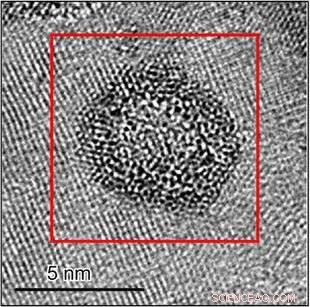
BF-STEM image highlighting the core–shell structure of the nanocluster. Credit: Nature (2016). DOI: 10.1038/nature19313
(Phys.org)—A combined team of researchers affiliated with the Army Research Laboratory at Aberdeen Proving Ground, Arizona State University and the University of North Texas has developed a nanocrystalline alloy that combines high mechanical strength with high-temperature creep resistance. In their paper published in the journal Nature, the team describes how they created the material and its properties. Jonathan Cormier with Institut Pprime, UPR CNRS offers a News & Views piece on the work done by the team in the same journal issue and outlines some of the hurdles that stand in the way of the alloy being used in industrial applications.
As Cormier notes, there are some applications (such as airplane engines) that require metal to be both extremely strong and resistant to creep (deformations that occur due to long term stress) at high temperatures. Currently, superalloys are used, but they have their limits, and for that reason, new alloys with better features are being created to provide benefits such as more efficiency (which could mean reducing fuel consumption). In this new effort, the researchers have found a way to improve creep with one nanocrystalline alloy they have developed—such alloys typically have poor creep resistance due to the extremely small grains used to make them.
To make their alloy, the researchers started with very small grains of copper and then added tantalum particles to the boundaries between the individual grains to prevent them from migrating—the source of creep. The result (which involved multiple millings at −196°C) was an alloy with excellent creep properties due to a stable microstructure—testing showed it to be approximately six to eight magnitudes of order better than other nanocrystalline alloys.
The development of the alloy is significant because it shows that a nanocrystalline alloy could be made to be creep resistant; yet there are still problems preventing its use in industrial applications—as Cormier notes, foremost among them are concerns about whether the process could be ported to mass production. Also, the increased density boundaries in the alloy make it more susceptible to oxidation and the creep resistance of the alloy needs to work at higher temperatures than the new alloy can sustain.
© 2016 Phys.org