Credit: Small (2016). DOI: 10.1002/smll.201601846
(Phys.org)—A combined team of researchers from the Harbin Institute of Technology in China and the University of California in the U.S. has developed a nano-sized, remotely controlled fish that is able to swim in liquids when a magnetic field is applied. The team has published the details of their research in the journal Nano Small Micro.
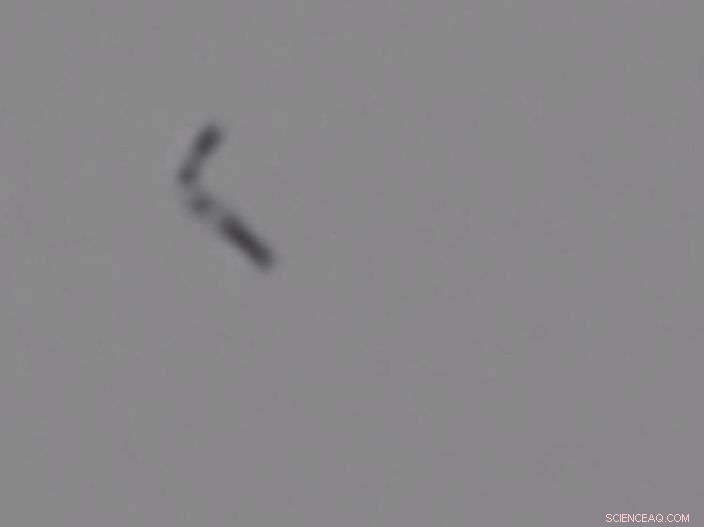
Prior efforts to build extremely small bio-transport mechanisms have generally been based on the corkscrew-tailed model of bacteria, the researchers note, but they believed a better approach would be to mimic the way fish swim. To that end, they connected gold and nickel segments together with silver hinges—the outer segments made of gold serve as the head and tail, while the inner segments serve as the fish body. Each of the segments are just 800 nanometers in length and the complete fish is a hundred times smaller than a single grain of sand.
The fish is caused to swim by applying an oscillating magnetic field that forces the head and tail to swing, which in turn propels the fish forward. The direction the fish takes and the speed at which it moves can be controlled by manipulating the position and speed of the oscillating magnet. The purpose of such nanoswimmers, the team proposes, is to carry medicine to a particular part of the body, thereby reducing the need for surgery or overuse of drugs that can cause negative side effects in other parts of the body. An accompanying video demonstrates not only the ease with which the fish can be controlled, but the speed at which they can travel—an obvious improvement over other nano-delivery systems.
There are still some big issues to address with the tiny fish, the team acknowledges—one of which is how to rid the body of the swimmers after they have delivered their package. One solution they suggest is using material that at some point is biodegradable. There is also the cost—the amount of precious metals used to create a single fish would be small, but it could add up quickly if hundreds of the fish were used to deliver doses of medicines. Also, it would seem that a means for tracking the fish would have to be developed to allow for micro-steering.
© 2016 Phys.org