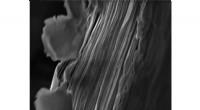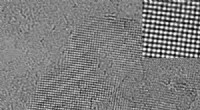
Self-animated graphene sheets assemble spontaneously into multi-layer ribbons. Credit: (c) Domhnall Malone
(Phys.org)—A pair of researchers with Trinity College in Ireland has found that graphene sheets are capable of spontaneous tearing when heated, which results in peeling and the creation of ribbons. In their paper published in the journal Nature, James Annett and Graham Cross describe how they happened across the new property of graphene, their studies of it, and possible ways it might prove useful.
Graphene continues to be the focus of studies by researchers around the globe, due of course, to its interesting properties—and as a result, researchers are finding out about more and more of its characteristics. In this new effort, the researchers report that when a sheet of graphene experiences a small puncture, parts of the sheet peel back, creating small ribbons of graphene. They came across this finding by accident. They note that as they were testing sheets of the material for friction properties after heating them to 150° C, a small, flower-shaped defect appeared in one.
A closer look revealed that the defect had been caused by a single hole in the original sheet. Intrigued, the team heated another sheet and then poked it with a bit of diamond that had a sharp, three-sided point. The researchers watched as the material around the hole peeled back spontaneously, creating three tiny strips of graphene that lay flat against the original surface. It was the creation of the ribbons that excited the researchers, not the hole—in its native state, the strips grew wider as they grew longer. In one test, they noted that the individual ribbons were approximately 0.6 micros at their thinnest end and tapered at a 15 degree angle—they grew to be approximately 1.5 microns wide at the other end. They report also that rubbing a newly made hole with the tip allowed them to control the peeling to a minor extent.
The researchers plan to continue their study of the peeling effect, looking for a way to cleanly control the process—they believe doing so might present a new way to create transistors, capacitors or other electronic devices.
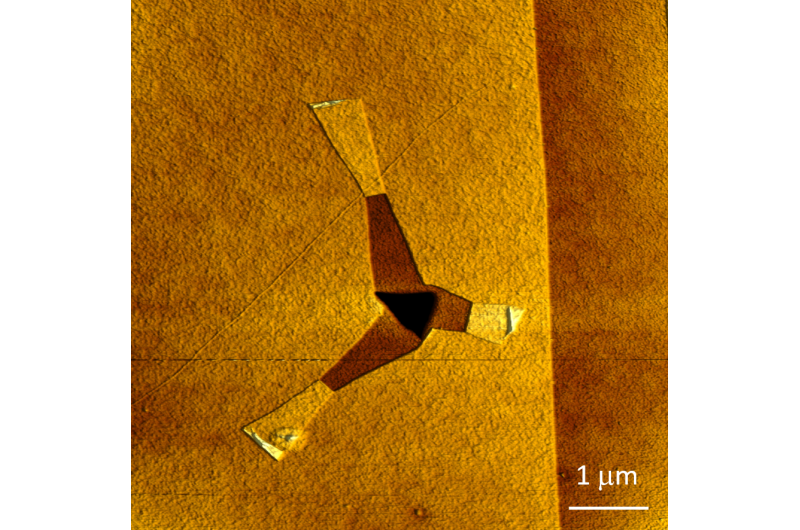
Three graphene ribbons formed from a fretted contact by self-assembly Credit: (c) James Annett
© 2016 Phys.org