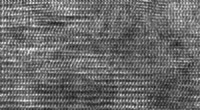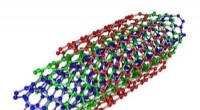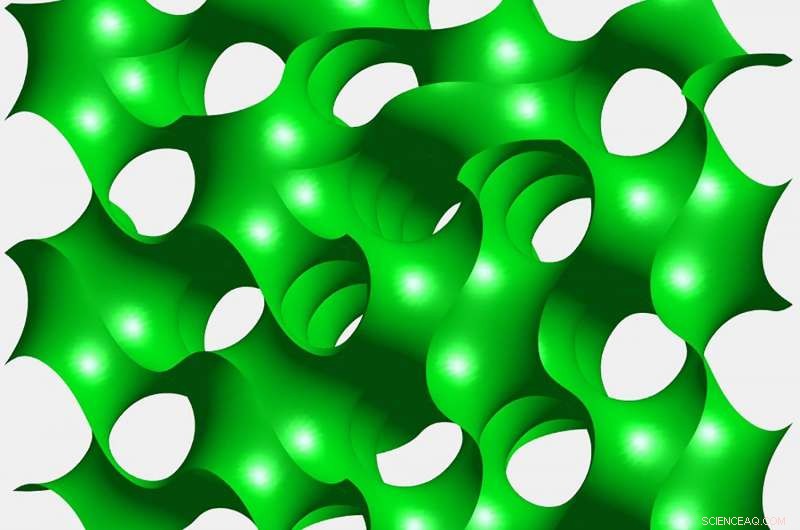
This image illustrates what a gyroid looks like. Credit: Zongsong Gan
(Phys.org)—A team of researchers with Swinburne University of Technology in Australia has found a way to use two-beam super-resolution lithography to create 3D photonic "gyroid" nanostructures—similar to those found in butterfly wings. In their paper published in the journal Science Advances, the team describes their technique and some applications to which it might be applied.
Scientists have known for some time that butterfly wings have "gyroid" nanostructures in them (arranged in grid patterns), that serve the butterflies by manipulating light in useful ways. In addition to their photonic properties, the structures, which are made of intertwining curved surfaces, were also found to be very strong for their size, which has caused scientists to see if they might find a way to create them artificially. Up till now, such efforts have left a lot to be desired—most do not have a high enough resolution or are too fragile. In this new effort, the researchers report that rather than rely on traditional methods, such as two-photon polymerization, the team went with optical two-beam super-resolution lithography—they compare it to direct laser writing techniques, noting that it has two major advantages over other techniques used in the past. The first is that it offers much better resolution and the second is that the resulting structure has more mechanical strength.
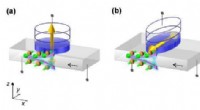
The two-beam laser approach works by utilizing, as its name implies, two lasers—one of the lasers is used to etch as is done with other etching techniques. It is the second laser that is different, it is delivered in a doughnut shape which allows it to act as an eraser of sorts, holding back the first laser, preventing etching where it is not wanted. The technique allows for creating gyroid structures in a grid shape that can then be used to create unit cells. The combined lasers allow for etching at very high resolutions, creating structures as small as 300 by 90 nm, a factor of ten smaller than is practical with a single beam etching approach.
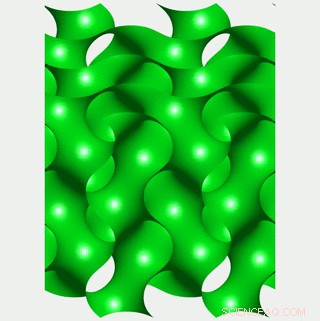
The structure of a gyroid. Credit: Zongsong Gan
The researchers note that structures they created were actually better than those made by butterflies (they were more uniform), which they say should make them ideal for use in photonics and optic technologies. They might also be useful in optoelectronics devices because they can be made smaller than those currently in use, allowing for more of them to fit on a chip. And because of their strength, device makers will not have to worry about collapse.
© 2016 Phys.org