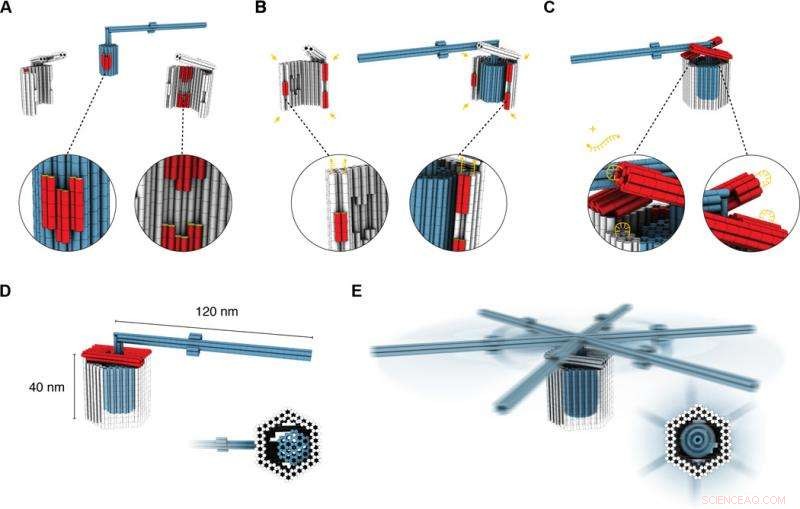
Design of a DNA-based rotary apparatus. Credit: (c) Science Advances (2016). DOI: 10.1126/sciadv.1501209
(Phys.org)—A trio of researchers with Technische Universität München has built a nanoscale apparatus that could one day serve as the basis for an extremely tiny motorized device. In their paper published in the journal Science Advances, the team describes how they built their device, how it works, and where they plan to take the new technology.
Scientists dream of building ever smaller motorized devices that could putter around inside the human body delivering medicines to ailing parts, toxins to tumors or simply serving as health monitors, but alas, such devices have not yet come to fruition—but they may be getting closer. In this new effort, the team in Germany has built a device based on synthetic DNA parts—it mimics, somewhat, the activities of flagella, the tiny arm-like appendages bacteria use as paddles to move around. It is only 40 nanometers tall but includes three main parts, a crank that spins, an axle bearing and a container to hold the other two parts together.
It does not yet have a power source, thus it cannot be called a motorized device just yet, instead, it can move around due to thermal energy which creates colliding water molecules which in turn causes the crank to turn—the team cannot control the direction of the device yet either, but believe they may have a solution sometime in the near future. They plan to test ideas using laser heat, ion flow or even chemical reactions to cause the crank to turn, and hopefully allow for controlling direction. If they succeed such a tiny motorized device would be useful in more than just medical applications—it could also possibly be used to drive chemical syntheses or to pump molecules across barriers.
The tiny device built by the team represents the first example of a biologically inspired nanomachine capable of demonstrating dynamic motor-like behavior. It also represents a step forward in nanoarchitecture—the device was built molecule-by-molecule and perhaps is the first step towards the development of true nanorobots. They note also, that after watching their device in action, it is not difficult to envision such devices motoring around inside of people, in a way very similar to how bacteria get around.
© 2016 Phys.org