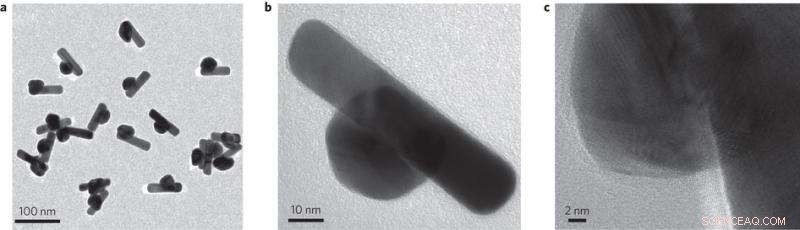
Optical black body, the fabrication of which occurs via seeded growth of Au nanospheres from Au nanorods. a, Low-magnification TEM image of a realized sample. b, TEM image of a single nanostructure. c, HRTEM image near the kissing point between the nanosphere and the nanorod. Credit: (c) 2015 Nature Nanotechnology (2015) doi:10.1038/nnano.2015.228
(Phys.org)—A team of researchers at King Abdulla University of Science and Technology in Saudi Arabia has made the blackest material ever created by human beings. As they note in their paper published in Nature Nanotechnology, the idea for the material came from the all-white cyphochilus beetle.
As the researches also note, it is likely impossible to create the perfect black material that absorbs all of the energy that strikes it, and then emits it without any loss of energy. Still, scientists would like to come closer because it is believed that such materials could help in creating better or more efficient devices, such as solar collectors. In this new effort, the team bested the blackness of previous materials using carbon nanotubes by emulating what they found when studying the all-white cyphochilus beetle. The result was a an extremely tiny nanoparticle rod resting on an equally tiny nanoparticle sphere (30 nm diameter), which was able to absorb approximately 98 to 99 percent of the light in the spectrum between 400 and 1,400 nm, which meant that it is able to absorb approximately 26 percent more light than any other known material—and it does so from all angles and polarizations.
The researchers noted that the scales on the cyphochilus beetle—a photonic crystal structure—caused the beetle's shell to reflect light very efficiently. They took that idea and turned it on its head by inverting the structure and used the idea of chaotic energy harvesting to create the extremely black material—the surface of the structure is disordered, which creates a pattern of random pits, each consisting of infinitely long metallic waveguides. As a bonus, the material can be easily created and applied and used both in and out of liquids. Also, by firing a laser at it, they created a new type of light source that generated monochromatic emissions without the necessity of resonance.
The team notes that devices using such an application might be used for desalination projects, and, of course, in solar energy collecting systems, and perhaps in optical interconnects. They also suggest the material might even lead to using a wholly new approach in the design of such devices.
© 2015 Phys.org