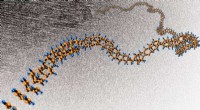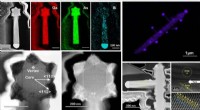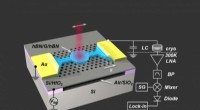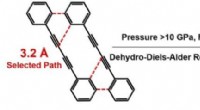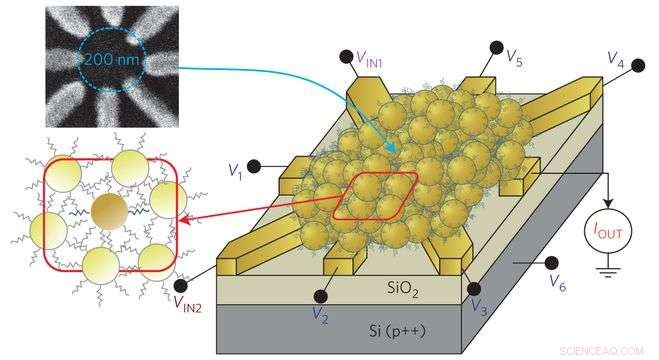
Schematic of the device layout and working principle. Credit: (c) 2015 Nature Nanotechnology (2015) doi:10.1038/nnano.2015.207
(Phys.org)—Natural computers, such as evolved brains and cellular automata, express sophisticated interconnected networks and exhibit massive parallelism. They also adapt to exploit local physical properties such as capacitative crosstalk between circuits. By contrast, synthetic computers channel activity according to established design rules and do not adapt to take advantage of their surroundings. Thus, researchers are interested in using matter itself for computation.
Scientists have speculated about the ability to evolve designless nanoscale networks of inanimate matter with the same robust capacities as natural computers, but have not yet realized the concept. Now, a group of researchers reports in Nature Nanotechnology a disordered nanomaterials system that was artificially evolved by optimizing the values of control voltages according to a genetic algorithm.
Using interconnected metal nanoparticles, which act as nonlinear single-electron transistors, the researchers were able to exploit the system's emergent network properties to create a universal, reconfigurable Boolean gate. The authors note that their system meets the requirements for a cellular neural network—universality, compactness, robustness and evolvability. Their approach works around the device-to-device variations that are becoming increasingly difficult to align as semiconductors approach the nanoscale, and which result in uncertainties in performance.
Their system is a disordered nanoparticle network that can be reconfigured in situ into any two-input Boolean logic gate by tuning six static control voltages. It exploits the rich emergent behavior of up to 100 arbitrarily interconnected nanoparticles. For the experiment, the researchers used 20 nm gold nanoparticles interconnected with insulating molecules. These single-electron transistors express strongly nonlinear switching behavior, and the researchers looked for logic gates among the mutual interactions between them.
The fastest method proved to be artificial evolution. They developed a genetic algorithm that followed the well-known rules of natural selection, considering each control voltage as a gene and the complete set of system voltages as a genome. The best-performing (i.e., "fittest") genomes were preserved and improved via a composite cloning-breeding approach. The desirable traits of the initial, mostly low-performing genomes were passed selectively to subsequent generations.
For each logic gate evolved, the genetic algorithm almost always converged to a viable genome within less than 200 generations. The researchers note that due to the slow input signals they used, the process took about an hour; optimizing the system set-up could result in faster evolution.
"Using the artificial evolution procedure... we succeeded to realize fully configurable, robust Boolean logic in disordered nanoparticle networks at our base temperature of ~0.3 K. These results comprise the first experimental demonstration of exploiting disordered matter at the nanoscale for computational functionality," the authors write.
They note that the system meets the criteria for the physical realization of cellular neural network and that the same evolutionary approach with a more sophisticated electrode layout could yield many more computational tasks. "Our evolutionary approach works around device-to-device variations at the nanoscale and the accompanying uncertainties in performance, which is increasingly becoming a bottleneck for the miniaturization of conventional electronic circuits. The results, therefore, also need to be seen in the light of these exciting possibilities," they write.
© 2015 Phys.org