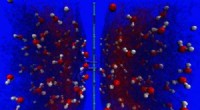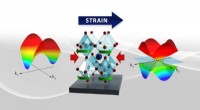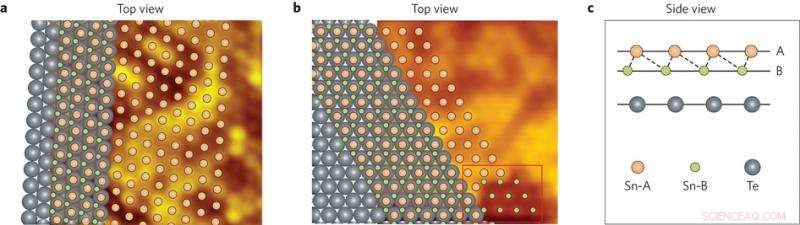
Atomic structure model for the 2D stanene on Bi2Te3(111). Credit: Nature Materials (2015) doi:10.1038/nmat4384
(Phys.org)—A team of researchers with members from Stanford University and several institutions in China is claiming to have found a way to create a sample of stanene—a one-atom thick mesh (buckled honeycomb) of tin that theories have predicted could be used to conduct electricity with zero loss due to heat. In their paper published in the journal Nature Materials, the team describes the process they used to create their sample and the problems they encountered when trying to test its conductivity.
Graphene has been in the news a lot of late, as scientists have found many uses for it—the one-atom thick sheets of carbon have excellent electrical (and other) properties. But even as research with graphene continues, other scientists have been looking for a way to create stanene (which was predicted to possibly exist just two years ago) because it is believed it could be used to drastically improve the process by which electricity is used in electronics. Electrons, it is believed could travel through the material at room temperature without bumping into other electrons, as occurs with other materials, causing vibrations, resulting in heat—and loss of energy from the medium. With stanene, the electrons would travel along just the edges of the mesh—it could not get into the center because of quantum spin properties—making it a topological insulator. If theories about stanene turn out to be true, wires could be made that would carry electricity great distances from a source to a destination without energy losses, for example, or phones and their chargers could operate without getting hot.
To make their sample, the researchers vaporized a bit of tin inside of a vacuum chamber allowing it to form its characteristic mesh on a bismuth telluride surface. The team was able to see only the top ridges of the structure with a scanning tunneling microscope, however and believe the substrate interacted with the mesh, preventing conductivity testing. In order to get a better view, the team acknowledges that they will have to create a bigger sample. Others have already suggested that it might be possible to confirm the structure of the material using X-ray diffraction.
© 2015 Phys.org