Credit: ACS
(Phys.org)—A small group of researchers with China's Jilin University has developed a triple-layer coating that protects cotton from water and fire and is easily cleaned. In their paper published in ACS Nano, Shanshan Chen , Xiang Li , Yang Li and Junqi Sun describe how in searching for a way to make fire retardants last longer on materials, they hit upon an idea that also made such materials water resistant.
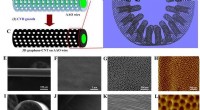
The problem with many fire retardant coatings, the researchers point out, is that extended use or repeated washings tends to reduce the effectiveness of the coating. They wondered if adding a water resistant coating might help make a retardant last longer. To find out, they started by dipping a strip of cotton into polyethylenimine, a polymer that is commonly used as a binding agent. Next they dipped the same strip into a vat of ammonium polyphosphate, which is commonly used as a flame retardant. Then they dipped the same strip into a solution consisting of silsesquioxane (a cage-like molecule) and ethanol, which when mixed tends to be hydrophobic.
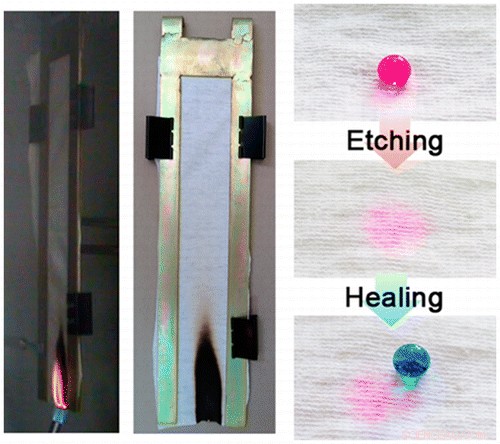
The team then tested the material to see if the coatings would work as they hoped. They hung the strip and then set fire to it at its base—as can be seen in a video they made, the untreated strip quickly catches fire and is soon engulfed—the entire strip is reduced to ashes. The treated strip on the other hand burns for just a few seconds at the base and then goes out.
The team explains that the fire retardant works by swelling when heated, which causes a gas to be released that prevents the fire from getting oxygen. The hydrophobic coating works in a way similar to duck feathers, water is repelled at the nanoscale—the coating works by topping a porous base with a rough skin with cage-like molecules.
To find out if their coating could withstand ordinary wear and tear, the team subjected treated strips to O2 plasma and by mechanically rubbing it 1000 times. Afterwards it still was resistant to fire and water.
The researchers report that the material was also made self-healing by adding a second layer of hydrophobic molecules—when the first layer is damaged, air seeps in and the water in it causes molecules from the second layer to fill gaps in the first layer.
© 2015 Phys.org