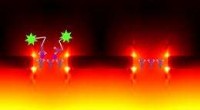
Credit: ACS Nano, DOI: 10.1021/acsnano.5b00706
(Phys.org)—A team of researchers working at the Georgia Institute of Technology has developed a type of smart-glass that not only changes color, but creates electricity. They have published a description of their work and the glass they have produced and some ideas on what the new kind of glass might be used for in their paper published in ACS Nano.
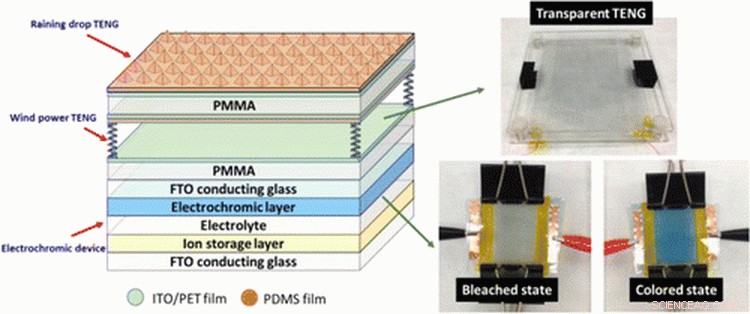
Many types of smart-glass have been created, some that display a tint when it gets sunny out, others that change to prevent heat from coming in, etc. In this new effort, the researchers sought to add something new—production of electricity. Realizing that many types of glass are subjected to rain and wind, they sought to find a way to coat a window that would take advantage of triboelectrics—capturing the energy in static electricity that occurs when two materials meet.
They came up with a two layer solution, one layer to capture the energy in raindrops, the other to do the same for wind. In the first layer, the researchers developed nano-sized generators that would take advantage of the positive charge in raindrops that develops as it rubs against air on its way down from clouds and then as it crashes into a car's windshield. The second layer consisted of a sandwich of two charged sheets of plastic with tiny springs between them. As wind pressure develops on an accelerating vehicle, the plastic sheets are pushed closer together, creating an electric current.
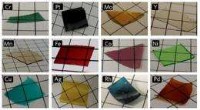
Together the two layers result in a glass that is initially clear, but then develops a blue tint—they also generated as much as 130 milliwatts of electricity per square meter of glass, which the researchers point out, is enough to charge a sleeping smartphone. Moving forward, the team suggests that such types of glass could be used with wireless networks because it is not based on a separate power source. But, before that can happen, the team is looking into ways to store the power that is generated. They think it might be possible to embed see-through super-capacitors in the glass as well. At this time, it is not clear how much glass with all that embedded technology would cost.
© 2015 Phys.org