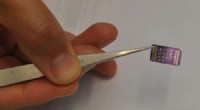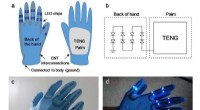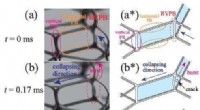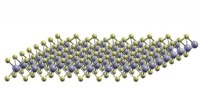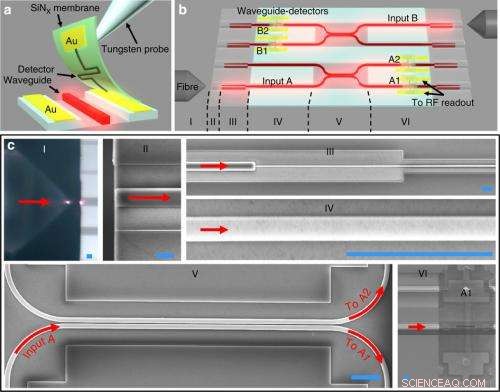
Assembly of high-system-efficiency PIC with integrated detectors via membrane transfer. (a) Membrane transfer of an SNSPD onto a photonic waveguide. (b) Sketch of photonic chip with four waveguide-integrated detectors (A1, A2, B1 and B2). (c) Micrographs of sections I–VI labelled in b. Infrared light (red arrows) was coupled from a lensed fibre (I) with a spot diameter of 2.5 μm into a 2 × 3 μm polymer coupler (II). The coupler overlapped with a 50- to 500-nm-wide inverse-tapered section of a silicon waveguide (III). The input light travelled along the 500-nm-wide waveguide (IV) over a distance of 2 mm before reaching a 50:50 beam splitter (directional coupler in V) followed by the waveguide-integrated detectors (VI). The equivalent length of the scale bar (blue) is 3 μm. Credit: Nature Communications 6, Article number: 5873 doi:10.1038/ncomms6873
A large team of researchers with members from MIT, IBM, NASA's JPL and Columbia University has developed a process that that enables scalable integration of superconducting nanowire single-photon detectors (SNSPDs) on a range of photonic circuits. In their paper published in the journal Nature Communications, the team describes their new process and why they believe it may lead one day to a practical photonic quantum processor on a chip.
Scientists have been hard at work trying to build a quantum computer for several years, and while the results have at times been promising, there is still clearly a long way to go. For such a computer to work, a quantum processor of some sort must be created. The current thinking is that such a processor will likely be photon based (because they are relatively easy to entangle and because they can be manipulated easier than other types of quantum bits) and it will have to be chip based. In this new effort, the researchers have created a process that allows for performing scalable integration of SNSPDs on several different kinds of photonic circuits.
For a quantum computer based on photons to work, logic suggests, it will need to be able to detect and process single photons. SNSPDs are thought to be the most promising single photon detectors developed thus far, but, sadly, processes developed for building them have been plagued by a high numbers of defects. In this new effort, the researchers have developed a process that allows for building each detector separately, and putting only those that are defect-free onto an optical chip. The process also calls for building the optical chips separately using standard chip making fabrication techniques.
The team reports that their process allows for building detector arrays that are larger and denser than those built before—and they are more sensitive as well. They proved their claims by building detectors capable of handling 20 percent of photons sent their way—ten times better than previous methods. Each was made on micron-sized membranes and those that passed testing, were transferred to a waveguide using an optical microscope.
The team is continuing their research, now focusing on building larger on-chips systems with more capabilities.
© 2015 Phys.org