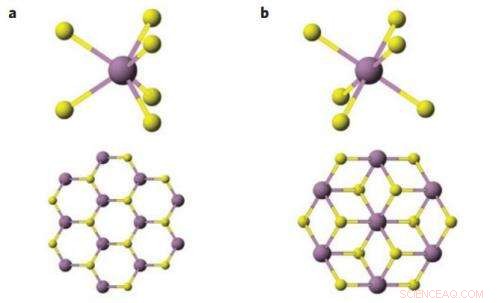
Crystal structures of the 2H and 1T phases, respectively. In the upper diagram, trigonal prismatic (a) and octahedral (b) coordinations are shown. The lower panel shows the c-axis view of single-layer TMD with trigonal prismatic (a) and octahedral (b) coordinations. Atom colour code: purple, metal; yellow, chalcogen. Credit: Nature Materials (2014) doi:10.1038/nmat4080
(Phys.org) —A team of researchers with members from Rutgers University and Los Alamos National Laboratory has found a way to get around the problem of metals forming high-resistance when deposited on 2H phase molybdenum disulphide (MoS2). In their paper published in the journal Nature Materials, the team describes how they came up with a process for inducing 2H phase nanosheets to the metallic 1T phase, thereby reducing contact resistance.
While carbon nanotubes have dominated the headlines in the search for the basis of the next generation of computer chips, scientists have been making inroads using other materials as well—one in particular, MoS2, has shown promise. It's actually been used to create working electronic devices. Unfortunately, its use in mass producible devices has been limited by the same constraint as that found with carbon nanotubes—the resistance that occurs when attempting to connect the semiconductor to other electronics. The problem comes about because the sheets are so thin, attempting to attach wires has been problematic and research into doping methods has not gone well. In this new effort, the researchers have found a way to change the phase of a sheet of MoS2 from a semiconductor, to metallic, i.e. a fully conducting contact.
The idea is that if a tiny section of a MoS2 sheet can be phase shifted to a metallic state, then wires could very easily be connected to it, and that's exactly what they team has done—they developed a process they call lithiation which modifies the MoS2 to the metallic phase, by exposing the material to n-butyl lithium. To make sure it really works, they successfully built several field effect transistors using the modified sheets.
There are still some problems however, the team is having trouble finding a way to accurately phase shift just the part of a sheet they're after, and because MoS2 is metastable, it tends to shift back to its purely semiconductor phase under certain conditions, and the researchers aren't sure just yet what exactly those conditions are. The team is working on these issues, of course—one possible solution may be in producing MoS2 differently—creating flakes using exfoliation, perhaps or chemical vapor deposition.
© 2014 Phys.org