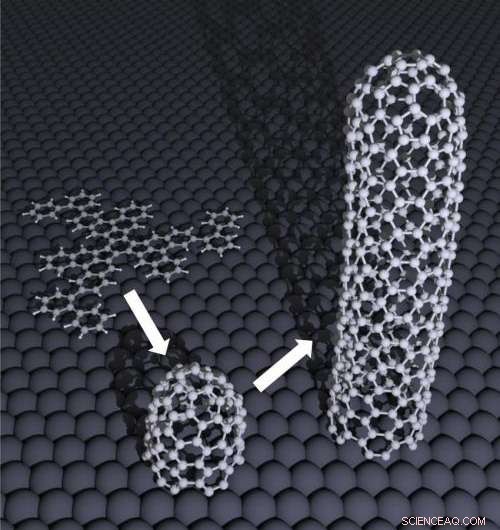
Dedicated molecular precursors enable carbon nanotube growth with unprecedented structural purity. On a Platinum surface, the planar hydrocarbon precursor folds into an end cap, that in turn acts as seed for the growth of a well-defined carbon nanotube. The image on the right hand side shows scanning tunneling microscopy images of the precursor, the ‘folded’ end cap, and the resulting (6,6) carbon nanotube, together with the corresponding structural models. Credit: Empa / Juan Ramon Sanchez Valencia
(Phys.org) —A team of researchers with members from Switzerland and Germany has developed a method for producing a specific single-walled carbon nanotube type with a predefined structure. They describe the procedure in their paper published in the journal Nature. James Tour offers a News & Views piece in the same journal discussing the groundbreaking work done by the team.
Carbon nanotubes, as most are aware, are tubes made of only carbon atoms, and quite often have walls that are just one atom thick (known as single-walled). Because of their unique properties, researchers have been creating and using them in a variety of applications ranging from solar cells, to light detectors and sensors. One serious hindrance to their widespread use has been an inability to mass produce single-walled carbon nanotubes that are all nearly exactly alike. Growing them using conventional methods results in nanotubes that have a variety of different shapes and sizes, thus using them requires separating out the ones that fit specifications, a time consuming and expensive process. In this new effort, the research team has developed a way to produce a "batch" of nanotubes that all have the same characteristics.
Carbon nanotubes types are defined by species, each has what is known as a chirality index that consists of two numbers—one describes tube diameter, the other the angle of the walls relative to the base when the tube has been rolled up. To create nanotubes that are all alike in one go, would mean creating a batch that are all of the same species with the came chirality index. To make that happen, the team began with predefined "seeds"—organic molecules that were specifically created for the purpose, using a multistep process. The seeds were placed on a platinum surface and then the whole works was heated to 500° centigrade—ethanol was used as the source for the carbon atoms. As the researchers explain, it's the arrangement of the atoms in seeds that determines the species of the nanotubes that grow. In their experiments, they grew carbon nanotubes with a (6,6) chirality index.

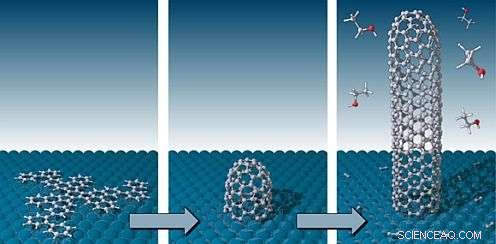
Selective growth of (6,6) single-walled carbon nanotubes on a Platinum surface. Tiny caps folded from a planar molecular precursor act as seeds for the growth of well-defined nanotubes by the incorporation of carbon from a gas such as ethanol or ethylene. Credit: Empa / Universität Erlangen / Konstantin Amsharov
The process is not without its problems, of course, the resulting nanotubes all come out standing upright, which tend to bundle as they grow longer—that could present problems for some processes. Also, the amount of material used for the base is significantly larger than for conventional methods adding extra cost. Despite these limitations, the achievement by the team is considered to be a major breakthrough in creating single-walled carbon nanotubes.
Selective growth of (6,6) single-walled carbon nanotubes on a Platinum surface. Tiny caps folded from a planar molecular precursor act as seeds for the growth of well-defined nanotubes by the incorporation of carbon from a gas such as ethanol or ethylene. Credit: Empa / Universität Erlangen / Konstantin Amsharov Selective growth of (6,6) single-walled carbon nanotubes on a Platinum surface. Tiny caps folded from a planar molecular precursor act as seeds for the growth of well-defined nanotubes by the incorporation of carbon from a gas such as ethanol or ethylene. Credit: Empa / Universität Erlangen / Konstantin Amsharov On a Platinum surface, the planar hydrocarbon precursor folds into an end cap, that in turn acts as seed for the growth of a well-defined carbon nanotube. Credit: Empa / Juan Ramon Sanchez Valencia

© 2014 Phys.org