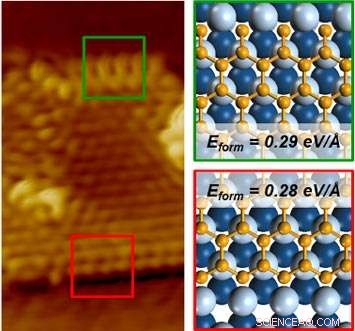
Figure 1 Left: High resolution Scanning Tunneling Microscopy image showing different structure on the top (green) and bottom (red) edges. Right: Atomic structures determined from theory that explain the images and the stability of the low coordinated carbon atom on the Klein edge.
Through high resolution scanning tunneling microscopy measurements and first principles Density Functional Theory based calculations, a novel atomic scale edge structure was shown to be stable for graphene islands grown on cobalt surfaces. The low-coordinated carbon atom at the Klein edge structure is stabilized by interaction with the cobalt surface. This is the first demonstration, combining experiment and theory, that the interaction of the carbon atoms with a metal substrate stabilizes the low coordinated carbon edge atoms. In models for the growth of graphene on metal substrates, such low coordinated atoms at the growing edge play a special role. These results, which demonstrate such stability, will play a significant role in further development of these models and will help guide future strategies to grow graphene nanostructures with atomic scale control of edge structure.
A leading method to produce graphene nanostructures with potential for new electronic devices involves chemical reactions and growth of the one-atom thick graphene on metal surfaces. Low-coordinated carbon atoms at the growing edge play a key role in leading models for the growth mechanism. This work can lead to improved growth and the needed atomic-scale control of structure.