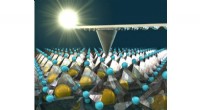
(Phys.org) —A team of researchers in Singapore has used plasmonic properties to create a photorealistic printing technique. In their paper published in Nano Letters, the researchers describe how they created pillars of hydrogen silsequioxane 95nm tall on a silicon substrate, each topped with an aluminum cap to take advantage of plasmon resonance, resulting in a printing palette of over 300 colors.
Back in 2012, a research team made up of many of the same members as this new team discovered it was possible to create a color image by using electron beam lithography to create tiny (95nm tall) pillars on a silicon substrate and then capping each with a bit of silver or gold. The pillars were arranged in groups of four, together serving as a single pixel capable of displaying up to one of 15 colors. The colors came about due to Plasmon resonance, where electrons on the surface of the metal oscillate at a certain frequency—only light at the same frequency as the oscillation is reflected back. Images can then be created by arranging the pixels in a desired pattern. In this new approach the researchers took the same approach but used aluminum for the caps.
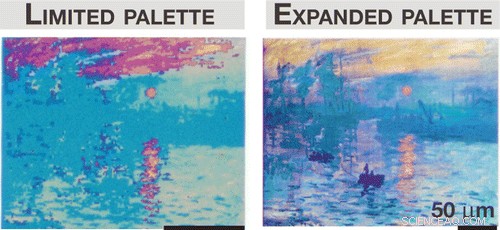
They found that by varying the distance between the pillars, varying how they were arranged and adjusting the diameter of the caps they could produce over 300 colors, all at a much lower cost. The researchers note that the aluminum caps are able to remain stable for over seven months, far longer than gold or silver. The downside is that the image produced isn't as vibrant.
As an example of what could be done with the new technique, the team faithfully created a very tiny (50 µm in length) replica of Monet's "Impression, Sunrise." They suggest the technique could be used for mass-patterning, similar in some respects to screen printing. That could be achieved, they suggest by using electron beam lithography to create a template that could in turn be used to create stamps for imprinting on other metals. Applications could range from tiny data tags to stamps that help prevent pirating of consumer products or counterfeiting money and for creating color changing biosensors.
© 2014 Phys.org