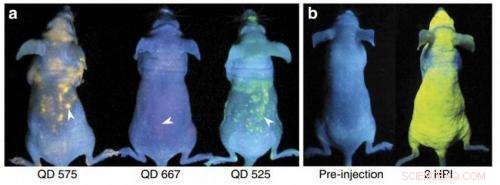
Mice injected with quantum dots. (a) Mice injected with quantum dots of different emission wavelengths (575, 667 and 525 nm) were simultaneously imaged at 2 HPI under a handheld ultraviolet light illumination. White arrows delineate points of quantum dot accumulation. (b) An example of a mouse pre- (left) and post (right) injection of quantum dots where fluorescence covers the entire skin. Credit: Nature Communications 5, Article number: 3796 doi:10.1038/ncomms4796
(Phys.org) —A number of years ago, a paper was published in Environmental Health Perspectives by Maureen Gwinn and Val Vallyathan that reflected concern about nanoparticles. Health experts ask: What are the long term health effects of nanoparticles? The authors wrote: "With the advent of nanotechnology, the prospects for using engineered nanomaterials with diameters of < 100 nm in industrial applications, medical imaging, disease diagnoses, drug delivery, cancer treatment, gene therapy, and other areas have progressed rapidly." They said that while potential for nanoparticles in these areas is infinite, possible toxic health effects associated with human exposure are unknown. This week, a technique that allows for the identification of nanoparticle distribution within mice simply looking at their skin has been reported which could be valuable in the search for answers.
The paper in Nature Communications was published Tuesday and is authored by a research team at the University of Toronto. The study, "Nanoparticle exposure in animals can be visualized in the skin and analyzed via skin biopsy," is by Edward Sykes, Qin Dai, Kim Tsoi, David Hwang and Warren Chan.
They found that different nanoparticles are visible through the skin under ambient or UV light. They found that after intravenous injection of fluorescent nanoparticles, they accumulate and can be observed through the skin. They also found that the concentration of these nanoparticles can be directly correlated to the injected dose and their accumulations in other organs.
In their discussion over selecting nanoparticles used in mouse skin, they said, "Gold nanoparticles are commonly used in molecular diagnostics and drug delivery applications. These nanomaterials were selected for our initial studies as they are easily synthesized, have a distinct ruby color and can be quantified by inductively coupled plasma atomic emission spectroscopy (ICP-AES)."
Work involved in the study included designing and performing experiments, pathological analysis, and data analysis. Their discovery could be used to better predict how nanoparticles behave in the body.
The authors wrote: "We show that intravenously administered inorganic nanoparticles at high doses are visible on the skin of mice under ambient light or through the use of inexpensive handheld devices such as ultraviolet lamps or dermatoscopes. We further show that elemental analysis of small skin biopsies can be used as a generalized approach to quantify the accumulation of gold nanoparticles and quantum dots within the body without the need of fluorescent or radioactive labels."
Examining their work on Wednesday, Anna Deming in nanotechweb.org noted "Possible toxicological effects from nanoparticles are still a cause of considerable concern. Studies have shown that nanoparticles tend to accumulate in the liver and spleen, but until now, there have been limited ways to monitor the exposure of these organs without taking a sample from the tissue itself – which could be fatal."
She said "Now, researchers at the University of Toronto have demonstrated that a glance at the skin can reveal the level of nanoparticle exposure, and that measuring nanoparticle content in a skin sample can quantitatively indicate the concentration within internal organs."
© 2014 Phys.org