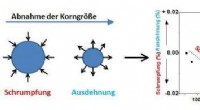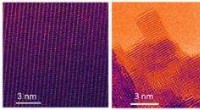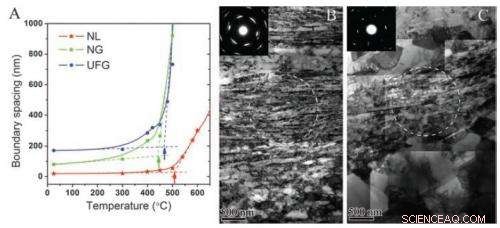
Thermal stability of the NL structure. Credit: Science 18 October 2013: Vol. 342 no. 6156 pp. 337-340 DOI: 10.1126/science.1242578
(Phys.org) —A team of researchers at the Chinese Academy of Sciences and Nanjing University of Science and Technology has found a way to create an ultra fine grain (UFG) nickel with a nanolaminated structure. As the team describes in their paper published in the journal Science, the result is a new process that allows for the creation of a form of nickel that is both harder and stronger than the metal is in its native form.
Ever since human beings first began using various metals they have been trying to modify them to conform to our wishes. Such efforts have resulted in an amazing array of metals ranging from the small amounts used in electronics to the mammoth steel girders that keep our skyscrapers upright. Research continues as scientists look for ever more advanced ways to treat metals to allow for ever more exotic applications. In this new effort, the team in China has developed a way to create a UFG from ordinary nickel. Such metals offer more resistance to corrosion and wear and have higher fracture strength.
UFG's advantages over other metals come about by causing a reduction in grain size—generally by a factor of ten or more. The smaller grain size means smaller grain boundaries which impede dislocation movement—it's dislocation that results in fractures or localized deformations.
To create a nickel UFG, the researchers subjected a rod made of 99.88 percent pure nickel to grinding on its surface—a process that tears away portions of the metal allowing for it to be shaped. In this case, the researchers noted that as nickel grains were being pulled by the mechanical grinder, the metal that remained was subjected to intense shearing causing what's known as plastic deformation. Upon closer inspection of the ground surface, the researchers discovered that two-dimensional nanometer-thick laminated structures had been created by the process. Further testing indicated that grain size had been dramatically reduced meaning that a nickel UFG had been created.
It's not yet clear if the simple process can be used to manufacture a nickel UFG on a scale large enough to be used in real world applications. What is clear, however, is that the process is very likely applicable to other metals, which means a whole new area of metal science might just be in the making.
© 2013 Phys.org