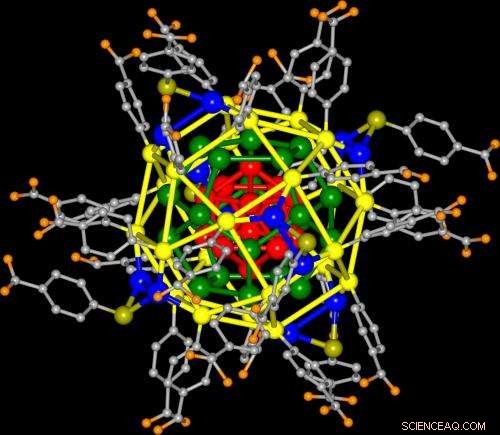
Image of the 44 silver atom cluster, consisting of a 32-atom Ag core (red and green) protected by six mounts, each containing two Ag atoms (blue) and five sulphur derivatives of benzoic acid (yellow is sulphur, grey is carbon, orange is oxygen). Credit: Bokwon Yoon
(Phys.org) —Two teams working independently of each other have developed very similar methods for creating silver nanoparticles that appear impervious to rust. One of the teams was from the U.S. and published their results in the journal Nature. The other team was from China and published their results in the journal Nature Communications.
Both teams were looking for a way to create silver nanoparticles that could be used as a replacement for the more expensive gold nanoparticles (used extensively in biomedical applications). Silver is more abundant and costs less but its sensitivity to oxidation makes it unstable, and thus unsuitable for most of the applications that gold nanoparticles are used for. To use silver as a basis for such nanoparticles the research teams had to find a way to cause them to be impervious to oxidation, and that's just what both have achieved.
Both teams wound up with nanoparticles that were made up of exactly 44 silver atoms. Likewise both teams used a similar technique to create the nanoparticles—mixing silver nitrates with reagents in ethanol and water. The difference between the two techniques developed by the two teams was in the sulfur bearing molecules used. In either case, both resulted in the formation of a solid core of 12 silver atoms. They were surrounded by another 20 atoms that served to hold the shape of the core. The rest of the atoms were used to create a sort of cage protecting the inner structure from outside influence. The end result was a silver nanoparticle that appears to be as impervious to oxidation as gold nanoparticles—all at a greatly reduced cost. The researchers suggest it behaves like a "superatom" because its structure prevents the loss of electrons to other chemicals. Another benefit the new technique offers is preciseness—every one of the nanoparticles produced has exactly 44 silver atoms produced in exactly the same configuration, making production easier because the process is more predictable.
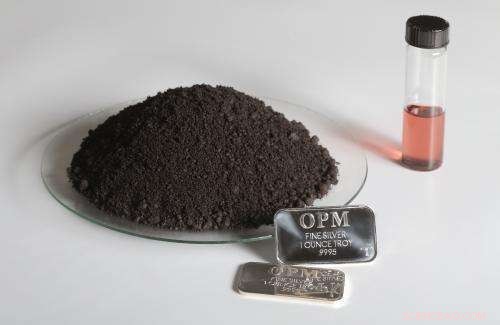
Dish containing 140 grams of silver nanoparticle powder pictured with a solution of the nanoparticles and 2 troy ounces of silver bullion, which is approximately the quantity of silver contained in the pile. Credit: Daniel Miller
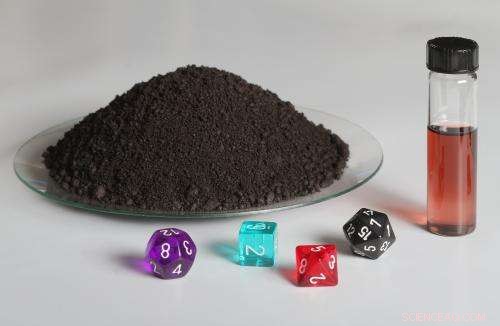
Dish containing 140 grams of silver nanoparticle powder pictured with a solution of the nanoparticles and 4 dice, which represent the shapes found within the highly symmetric cluster. They are 4 of the five Platonic solids: icosahedron, dodecahedron, octahedron, and cube. Credit: Daniel Miller
Gold nanoparticles have been used to help deliver drugs to internal bio-systems, to assist with imaging individual cells, and as biomarkers to highlight disease components. Now, it appears likely that the new technique developed by the two teams will allow for much cheaper silver nanoparticles to be used for such applications instead.
© 2013 Phys.org